
What this guide is for
Investment casting can replace a machined billet, forging, fabricated weldment, multi-piece assembly or another casting process when near-net geometry, alloy choice and downstream machining work together. It can also be the wrong process when the part is very simple, extremely large, dominated by broad loose-tolerance surfaces, or required in a volume/geometry combination better served by forging, sand casting, die casting, MIM or direct CNC machining.
This guide is written for buyers, design engineers, quality engineers and supplier-development teams. It focuses on the decisions that determine whether the process will be stable and economical in production rather than on a textbook definition of lost-wax casting.
At China Precision Metal, our current investment-casting route uses the silica-sol lost-wax process, covers 3 g–150 kg per part, has approximately 150 tons/month casting capacity, and can continue through 40+ CNC machines, finishing, inspection, material verification, NDT and pressure/leak testing where the drawing requires them.
Investment casting in one decision table
| Buyer question | Investment casting is usually attractive when… | Reconsider the process when… |
|---|---|---|
| Geometry | Several bosses, ribs, curved surfaces, flow paths or features can be integrated into one near-net part | The geometry is essentially a simple block, plate or shaft that machines efficiently from standard stock |
| Material | Stainless, duplex, carbon/alloy, heat-resistant or nickel-based alloys are required | A commodity material and very simple shape favor another high-volume process |
| Machining | Only critical faces, bores, threads, seats and datums need CNC finishing | Most of the casting would still be removed by machining |
| Assembly | Casting can eliminate welds, fasteners or multiple fabricated pieces | The assembly is intentionally modular or must remain separable |
| Volume | Tooling can be amortized across repeat production or a family of parts | Demand is one-off and geometry can be produced directly without tooling |
| Quality | Material, dimensional, NDT and functional checks can be linked to real service risks | The specification requires unrealistic universal perfection instead of defined functional acceptance |
| Supply model | Repeat releases, HMLV programs, safety stock or VMI can justify stable tooling and process controls | Design is still changing so quickly that hard tooling would become obsolete before validation |
1. Start with the finished function, not the casting
The best investment-casting RFQs begin by identifying what the finished component must do. A valve body may need pressure integrity, a stem bore, seat geometry and flange alignment. A pump housing may need a controlled seal face, bearing datum and internal flow path. A sanitary component may need cleanable geometry and a polished product-contact surface. A structural bracket may care mainly about stiffness, mounting position and repeatable assembly.
Those functional requirements determine which features can remain as-cast and which should be machined. They also determine where NDT, roughness, pressure testing or enhanced traceability actually create value.
A common sourcing mistake is to demand tight tolerances, very smooth surfaces and maximum inspection on every feature. That normally adds cost without improving function. Allocate precision and verification to critical-to-function zones.
2. The silica-sol lost-wax process from drawing to finished part
The process is a chain. A defect or ambiguity introduced early can reappear after heat treatment or machining, so buyers should understand the major control points.
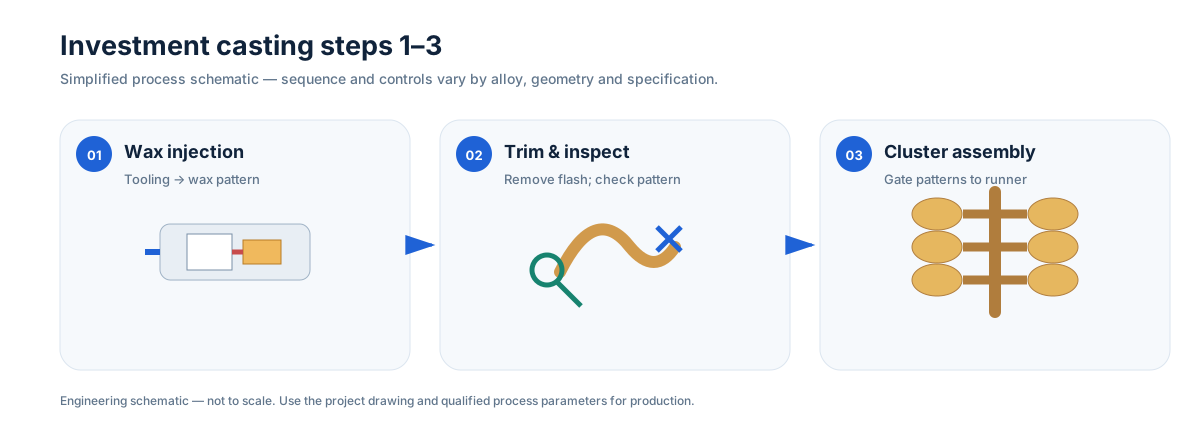
Drawing, DFM and tooling review
The supplier reviews alloy, geometry, shrinkage behavior, tooling direction, expected annual volume, machining stock, datums, critical surfaces and inspection requirements. This is the best stage to simplify a difficult feature or move precision from the casting to CNC machining.
Wax pattern production
Wax patterns reproduce the near-net component geometry. Pattern tooling must account for release direction, shrinkage, dimensional control and any soluble/core strategy. Wax quality and handling affect the geometry that the ceramic shell later reproduces.
Assembly and gating
Patterns are assembled to a feed system. Gating is not simply leftover metal: it controls how metal enters the mold, how the casting fills and how solidification is fed. Gate location also affects cut-off and blend areas, so critical cosmetic or functional surfaces should be considered before the tree is designed.
Ceramic shell building
Repeated dipping, stuccoing and drying build a ceramic shell around the wax pattern. Shell integrity must survive dewaxing, firing and molten metal. Deep pockets, trapped ceramic and difficult internal passages should therefore be considered during DFM rather than treated as cleaning problems at the end.
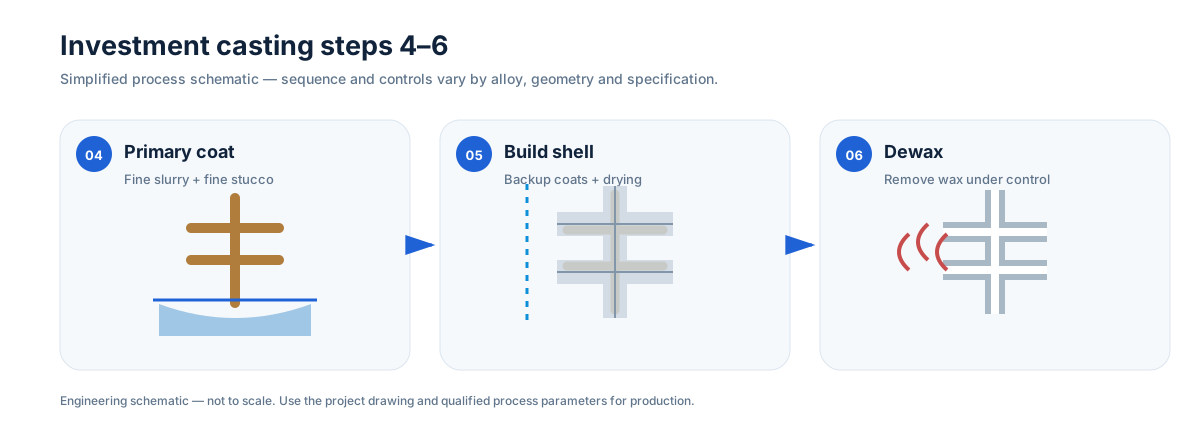
Dewax, firing, melting and pouring
Wax is removed, the shell is fired, and the specified alloy is melted and poured under the controlled route. Alloy chemistry, melt practice, shell temperature, pouring conditions and solidification behavior all influence the resulting structure and soundness.
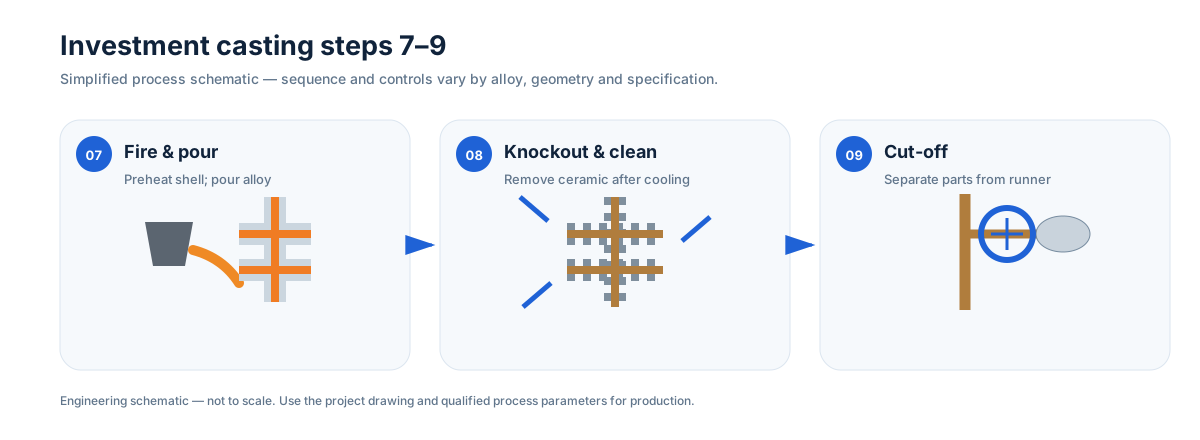
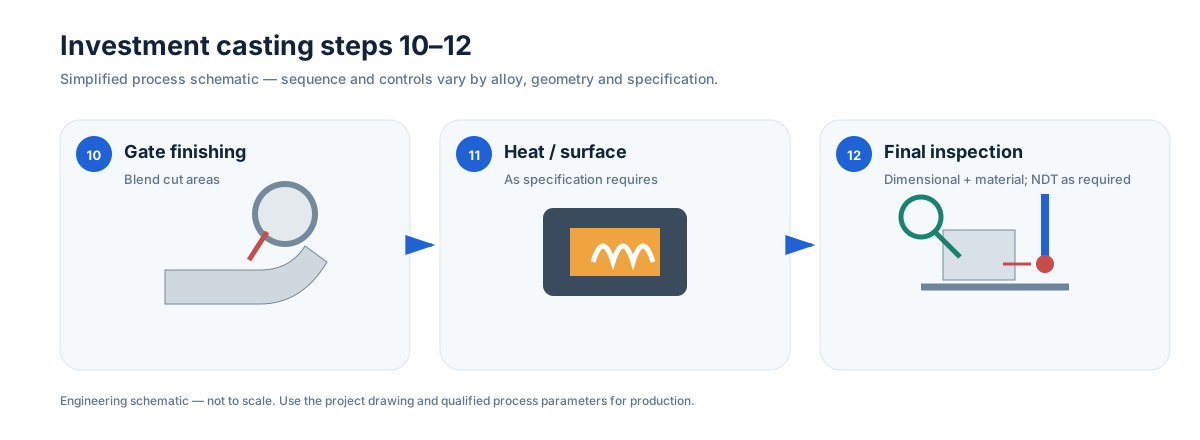
Knockout, cut-off and finishing
After solidification, ceramic is removed, parts are separated from the feed system and gate remnants are blended. The casting may then proceed through heat treatment, cleaning, straightening where permitted, machining, polishing/passivation and inspection depending on the specification.
3. Design geometry: what makes a casting robust
Investment casting supports complex geometry, but “complex” does not mean unlimited. Stable production depends on metal flow, shell strength, solidification and post-cast access.
Favor gradual section changes
Abrupt transitions from thin walls to isolated heavy sections can create filling and solidification challenges. Use radii and gradual transitions where the function allows. The goal is not identical wall thickness everywhere; it is a geometry that avoids unnecessary hot spots and impossible flow paths.
Use radii intentionally
Internal sharp corners are rarely desirable in a cast part. Radii can improve metal flow, reduce local stress concentration and make tooling/shell behavior more forgiving. Final radius size must still match the component function and available space.
Think about wax-tool release
Features that mechanically lock the wax pattern into the tool may require slides, inserts, soluble cores or a more complex tooling concept. If a feature can be simplified before tooling, the buyer often saves both tooling cost and long-term maintenance risk.
Integrate features only when integration adds value
Investment casting can combine bosses, lugs, ribs, pads and curved passages. Integration is most valuable when it removes machining, welding, assembly or leak paths. Do not integrate a feature merely because the process can form it if a modular feature is easier to service or control.
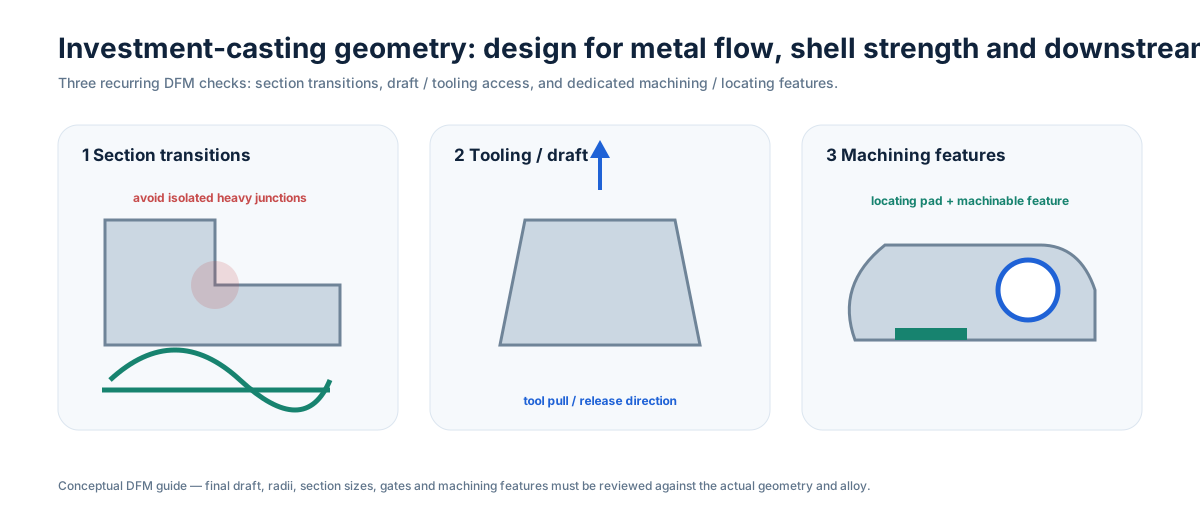
For geometry-specific detail, use the Investment Casting Design Guide ↗ and Minimum Wall Thickness guide ↗.
4. Wall thickness and section transitions
There is no single universal minimum wall thickness for all investment castings. Feasibility depends on alloy fluidity, total flow length, surface area, local geometry, shell conditions, part size and the relationship between thin and heavy sections.
Buyers should therefore avoid placing a generic “minimum wall” from a handbook onto every feature. The better approach is to identify:
- the thinnest functional zones;
- long flow paths into thin regions;
- large heavy junctions near thin walls;
- local stock required for machining;
- areas where wall thickness is part of a pressure boundary;
- features where cleaning/ceramic removal is difficult.
The Minimum Wall Thickness guide ↗ explains how to review these zones before tooling.
5. Material selection is part of process design
Investment casting is often chosen because it can form alloys that would be costly to machine from solid or difficult to fabricate into a complex pressure/flow shape.
Our current material scope includes families such as:
- austenitic stainless steels;
- cast stainless grades corresponding to common 304/316 families where specified;
- duplex and super-duplex families;
- carbon and low-alloy steels;
- precipitation-hardening stainless such as 17-4PH-class applications where specified;
- heat-resistant alloys;
- nickel-based alloy families.
Material selection should be based on the governing drawing/standard, corrosion environment, temperature, strength, weld/repair restrictions, heat-treatment condition, machinability and verification requirements. A commercial name alone is not enough for a controlled RFQ.
For duplex and super-duplex work, chemistry, heat treatment, phase balance, machining and verification need to be planned together. See the Duplex & Super Duplex Investment Casting guide ↗.
6. Dimensional tolerances: separate as-cast from machined requirements
Investment casting can hold useful near-net geometry, but the most economical drawing distinguishes between:
- functional dimensions that require CNC machining;
- controlled as-cast dimensions that influence assembly or downstream setup;
- reference/noncritical geometry where wider tolerance is acceptable.
Tolerances depend on size, geometry, alloy, parting/tool strategy, datum scheme, straightening/heat-treatment behavior and process capability. Avoid applying one tight ± value to every dimension.
Datum strategy is especially important. A drawing can unintentionally create a difficult tolerance chain by controlling a machined feature back to an unstable as-cast surface. Where function allows, create a machining datum system that can be established repeatably from the casting.
See Investment Casting Tolerances ↗ for a more focused discussion.
7. Machining allowance: stock is not “extra metal everywhere”
Machining allowance should exist where CNC needs enough material to clean up the surface and establish the finished feature. Excessive stock can create its own problems: longer cycle time, heavier casting sections, more tool wear and greater risk that machining opens a subsurface discontinuity.
Useful questions are:
- Which surfaces must clean up 100%?
- What casting datum will locate the first machining setup?
- How much local distortion is expected after heat treatment?
- Does the machined surface intersect the pressure boundary?
- Can a boss or pad provide stable workholding without becoming unnecessary finished mass?
- Is stock balanced around a bore/diameter rather than placed one-sided?
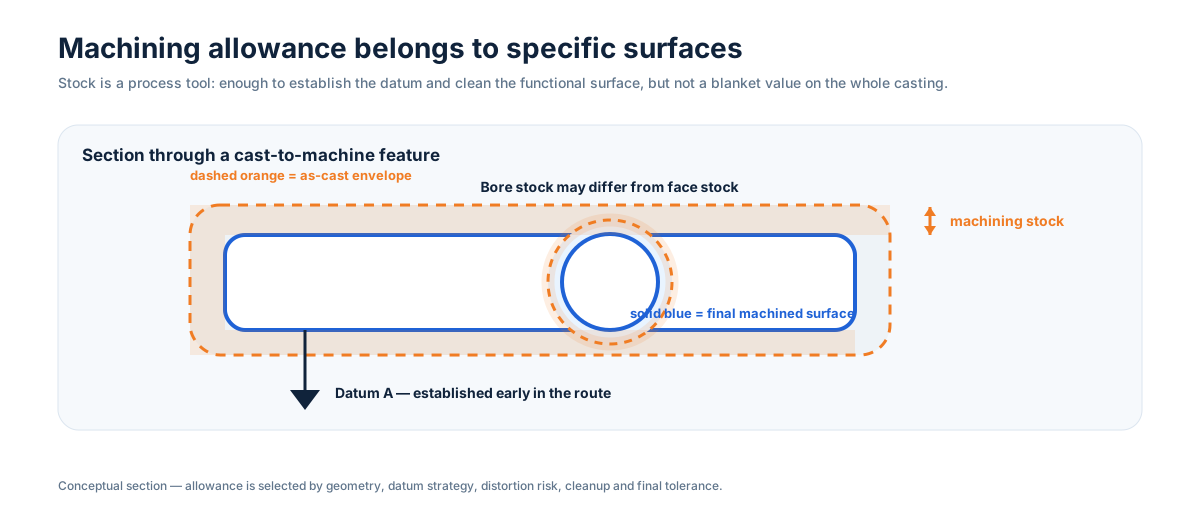
Use the Machining Allowance guide ↗ and Designing Castings for CNC Machining ↗ when planning the cast-to-machine route.
8. Cast-to-machine design: one route, not two disconnected suppliers
The most valuable investment-cast components are often not “finished” at cut-off. They become valuable after bores, threads, seats, sealing faces, bearing fits and datums are machined.
A cast-to-machine review should cover:
| Topic | Casting decision | Machining consequence |
|---|---|---|
| Datum pads | Provide stable, accessible locating geometry | Fewer unstable setups and easier repeatability |
| Stock | Local allowance on critical features | Sufficient clean-up without unnecessary cycle time |
| Distortion | Predict heat-treatment/section effects | Setup sequence can remove stock progressively |
| Clamping | Avoid weak or cosmetic regions | Fixture can restrain without marking/function loss |
| Pressure boundary | Identify machined wall intersections | Functional leak test can be placed after relevant machining |
| Inspection | Define final datums early | CMM/reporting matches finished drawing logic |
At our facility, 40+ CNC machines cover turning, milling, turn-mill, HMC, VMC and multi-axis work. This matters because the casting design can be reviewed against the actual downstream machining route before tooling release.
9. Surface condition: as-cast, blasted, machined and polished are different specifications
A casting drawing should distinguish the surface zones that matter:
- as-cast / shell-replicated surface;
- blasted or cleaned surface;
- gate-blend areas;
- CNC-machined surfaces;
- mechanically polished surfaces;
- passivated/electropolished surfaces where specified;
- cosmetic or product-contact zones.
A roughness number without a functional reason can create unnecessary work. A sealing face may require machining and a controlled Ra. A sanitary surface may require progressive polishing. A nonfunctional external casting may only need a consistent cleaned condition.
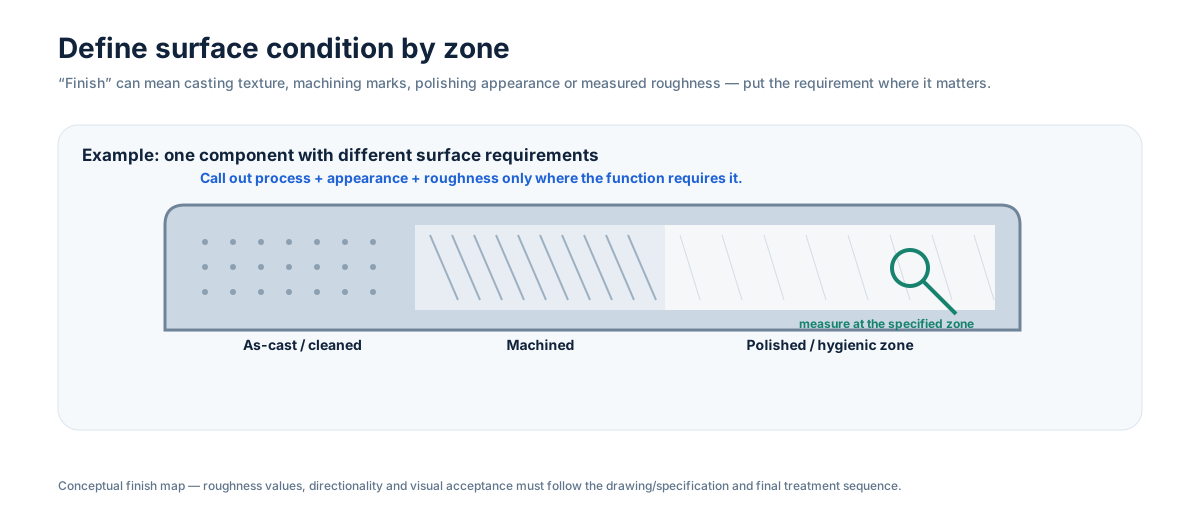
See Casting Surface Finish ↗ for a focused buyer guide.
10. Heat treatment should be connected to the final drawing
Heat treatment can affect mechanical properties, corrosion behavior, hardness, microstructure and dimensional stability. It can also affect the sequence of straightening and machining.
An RFQ should therefore state the required material condition or governing standard rather than simply “heat treat as necessary.” For some alloys, solution treatment, aging, stress-relief or other cycles are integral to obtaining the specified properties. For corrosion-critical alloys, the heat-treatment route can be just as important as the nominal chemistry.
Our Heat Treatment capability page ↗ explains how in-house and specialist external routes are coordinated according to the requirement.
11. Defects, discontinuities and realistic acceptance criteria
Casting is a metallurgical forming process. Quality should be defined by the component’s function, governing specification and agreed acceptance criteria, not by an undefined demand for “zero defects everywhere.”
Common issues that engineers may need to manage include:
- shrinkage-related discontinuities;
- gas or inclusion indications;
- misrun/incomplete fill;
- shell/ceramic-related surface conditions;
- hot tearing or cracking;
- dimensional distortion;
- gate/grind imperfections;
- exposed subsurface discontinuities after machining.
The correct response is not one universal inspection. It is a control plan that links design, process, NDT and finished-condition verification to the critical zone.
12. Repair, weld repair and impregnation must be specified—not assumed
Some castings may permit localized repair; others prohibit it completely or restrict it in pressure, fatigue, sealing or product-contact zones. The buyer should state the governing rule on the drawing or purchase specification.
Where controlled laser-weld repair is permitted, the material, location, procedure, post-repair finishing and re-inspection need to be agreed. Where impregnation is considered for pressure service, it likewise needs explicit approval and a defined sequence relative to machining and leak testing.
Do not discover repair-policy differences during first-article approval. Put them in the RFQ.
13. Pressure-tight castings require a system approach
A valve body, pump housing, manifold or liquid-cooling component can pass dimensional inspection and still leak if the pressure boundary is not controlled as a system.
Key questions include:
- Where exactly is the pressure boundary?
- Which machined surfaces intersect it?
- What service medium and operating condition apply?
- What NDT is required before/after machining?
- What leak or pressure test is required in the finished condition?
- Are repair or impregnation permitted?
- What is the acceptance criterion and sampling frequency?
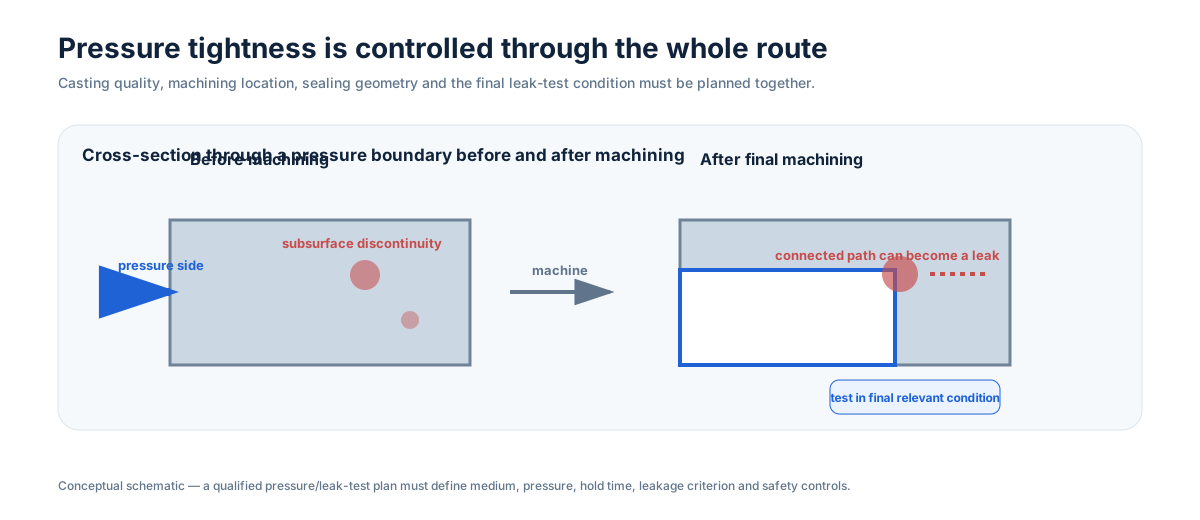
See Leak-Tight Cast & Machined Components ↗ and Porosity & Pressure Tightness ↗.
14. Quality planning: inspect the risks that matter
An effective casting control plan may combine:
- material chemistry verification;
- heat-treatment records where required;
- dimensional inspection and CMM reporting;
- surface/roughness checks;
- hardness testing;
- ferrite or other material-condition checks where applicable;
- penetrant, ultrasonic or radiographic examination according to requirement and suitability;
- pressure/leak testing for pressure-boundary components;
- traceability to the agreed lot/heat/documentation level.
At China Precision Metal, core inspection resources include Hexagon and Mitutoyo CMMs, spectrometry, ferrite and roughness measurement, Brinell/Rockwell hardness, pressure testing, plus coordinated NDT routes when specified. Specialist tests are coordinated when they sit outside the routine in-house route.
See Quality & Inspection ↗ and Inspection Equipment ↗.
15. First article and validation should prove the route, not only the dimensions
A first article is most useful when it validates the production logic:
- the correct alloy and heat-treatment condition;
- stable casting geometry and machining stock;
- critical dimensions and datums;
- functional surface condition;
- NDT and pressure/leak requirements;
- marking/traceability;
- packaging and supply documentation.
For repeat OEM programs, capture the approved route so later batches do not depend on tribal knowledge.
16. Cost drivers: where the money actually goes
Investment-casting cost is influenced by more than part weight. Major drivers include:
- tooling complexity and expected life;
- wax/core complexity;
- alloy cost and yield;
- tree/gating efficiency;
- shell-building difficulty;
- part size and pouring yield;
- heat-treatment requirements;
- grinding/blending and cosmetic requirements;
- CNC cycle time and number of setups;
- NDT and inspection scope;
- pressure testing;
- scrap/rework risk created by unrealistic specifications;
- annual volume and release pattern.
The lowest casting price is not always the lowest finished-part cost. A better near-net design may justify higher tooling or casting cost if it removes machining, welding, purchased subcomponents or inspection risk.
17. Tooling economics: prototype, bridge and repeat production
Tooling makes investment casting different from machining from solid. The commercial question is not “does tooling cost money?” but “what value does the tooling create over the expected program life?”
A repeat OEM component can justify tooling when it reduces recurring material removal, setup time, fabrication labor or assembly. For early prototypes or rapidly changing geometry, direct machining or additive patterns may sometimes make more sense until the design stabilizes.
When requesting a quote, provide annual demand and expected release size, not only the first purchase quantity. That gives a more realistic basis for tooling and production economics.
18. High-mix, low-volume programs are a different operating model
High-mix, low-volume (HMLV) work is not simply “small quantity.” It means multiple active part numbers, different revisions, smaller repeat batches and more frequent setup/inspection changes.
A capable HMLV supplier needs:
- drawing/revision discipline;
- tooling identification and maintenance;
- fixture and program control;
- flexible production scheduling;
- inspection plans tied to each part number;
- practical stocking/release options for repeat parts.
Our production model specifically supports HMLV industrial programs rather than requiring every project to behave like a high-volume commodity casting.
19. VMI, JIT and stocking can separate production economics from consumption rate
A customer may consume 50 pieces per month while the economical production lot is 200. That does not automatically mean the buyer must receive all 200 at once.
For repeat programs, we can structure vendor-managed inventory (VMI), safety stock, blanket orders, stock-and-release, Kanban replenishment and JIT delivery through agreed warehouse arrangements in the United States, Europe and China. Min/max, ownership, forecast inputs, release frequency and replenishment rules are program-specific.
See VMI, JIT & Stocking Programs ↗.
20. Compare investment casting with alternative processes
| Process | Usually strong when | Watch-outs |
|---|---|---|
| Investment casting | Complex near-net geometry, steel/high alloys, integrated features, moderate repeat volume, cast-to-machine parts | Tooling, process lead time, need to design for casting and finishing |
| CNC from solid | Low tooling commitment, prototypes, simple/medium geometry, very tight finished features | High material removal, long cycles on complex shapes, expensive alloy waste |
| Forging | High structural demand, favorable forged geometry, repeat volume | Shape limitations, substantial machining may remain |
| Sand casting | Larger parts, lower tooling cost, broad casting envelopes | Coarser surface/detail and often more machining |
| Die casting | High-volume nonferrous components and fast cycles | High tooling investment, alloy/process limitations |
| MIM | Very small complex parts at significant volume | Size/material/process window and tooling economics |
| Fabrication/welding | Large structures, sheet/plate/tube combinations, design flexibility | Weld distortion, leak paths, multiple components and labor |
For a five-route comparison, see Casting vs Forging vs CNC vs MIM vs Die Casting ↗.
21. Supplier qualification: questions worth asking
A buyer should be able to obtain clear answers to these questions:
- Which investment-casting process is used for this alloy/geometry?
- What is the realistic part-weight and capacity range?
- Which operations are in-house and which are controlled externally?
- How are alloy chemistry and heat treatment verified?
- How are tooling, wax patterns and revisions controlled?
- How is machining integrated into the casting plan?
- Which CMM/material/NDT/pressure-test resources are available?
- How are first articles and process changes documented?
- How are nonconformances and permitted repairs controlled?
- Can the supplier support repeat HMLV, VMI, JIT or second-source programs?
- Can the supplier show real parts similar in geometry/process difficulty?
- Is the quoted route based on the finished part, not only the raw casting?
Our Supplier Qualification page ↗ consolidates the current manufacturing scope, QMS, inspection and supply-program information for onboarding teams.
22. What to include in an investment-casting RFQ
For an efficient DFM and quote, send:
- native 3D model;
- controlled 2D drawing and revision;
- material grade and governing specification;
- annual volume and expected release/lot size;
- critical dimensions, datums and GD&T;
- surfaces that must be machined;
- surface roughness/polishing requirements by zone;
- heat-treatment and hardness requirements;
- NDT type, extent and acceptance standard if required;
- pressure/leak-test method, pressure, medium, hold time and acceptance if applicable;
- repair-welding/impregnation permissions or prohibitions;
- traceability, CoC, material-cert and inspection-report requirements;
- packaging/cleanliness requirements;
- target sourcing objective: new design, cost reduction, second source, reshoring support or capacity overflow;
- VMI/JIT/safety-stock requirements if repeat supply matters.
23. Common RFQ mistakes that slow quotation
Only sending a STEP file
A 3D model defines geometry but usually does not define tolerances, material standard, surface finish, testing, traceability or annual demand.
Only sending a 2D PDF
A drawing may not contain all the complex geometry needed for efficient DFM. Send both 2D and 3D when available.
Applying one tight tolerance everywhere
This hides which dimensions actually matter and makes the supplier price risk instead of function.
Saying “no porosity” without defining a functional zone
Identify pressure boundaries, sealing surfaces and critical machining intersections instead.
Asking for a piece price without annual quantity
Tooling, setup, batch size and supply model depend on the program, not only the first PO.
Defining leak testing without acceptance criteria
“Leak test required” is incomplete. Define the medium, pressure/vacuum, hold time, allowable loss/leak rate or visual pass/fail condition, and when in the process the test occurs.
24. China Precision Metal capability snapshot
| Capability | Current published scope |
|---|---|
| Investment casting | Silica-sol lost-wax process |
| Part weight | 3 g–150 kg |
| Casting capacity | Approximately 150 tons/month |
| Materials | Stainless, duplex, carbon/alloy, heat-resistant and nickel-based families to drawing/standard |
| CNC machining | 40+ machines; turning, milling, turn-mill, HMC, VMC, 3/4/5-axis routes |
| Finishing | Mechanical finishing, polishing, blasting, passivation/electropolishing where specified |
| Inspection | CMM, chemistry/material verification, hardness, roughness, ferrite and coordinated NDT |
| Functional validation | Hydrostatic and pneumatic pressure/leak routes where specified |
| Supply model | Prototype-to-repeat review, HMLV, second source, blanket order, stocking, VMI/JIT |
These are company-level capabilities, not universal limits for every part. Final feasibility depends on the drawing, alloy, geometry, quantity and acceptance requirements.
25. How to use the rest of this engineering library
Use this pillar guide as the starting point, then go deeper only where the part needs it:
- Investment Casting Process ↗
- Investment Casting Design Guide ↗
- Investment Casting Tolerances ↗
- Minimum Wall Thickness ↗
- Machining Allowance ↗
- Casting Surface Finish ↗
- Porosity & Pressure Tightness ↗
- Designing Castings for CNC Machining ↗
- Leak-Tight Cast & Machined Components ↗
- Duplex & Super Duplex Investment Casting ↗
26. Frequently asked buyer questions
Is investment casting only for small parts?
No. Practical size and weight depend on the foundry and geometry. Our published investment-cast part range is 3 g to 150 kg, but the drawing still determines feasibility.
Does investment casting eliminate CNC machining?
Sometimes it reduces machining substantially; it rarely eliminates all machining on parts with precision bores, threads, seats, sealing faces or controlled datums. The best design uses casting for near-net form and CNC for functional interfaces.
Is investment casting always cheaper than machining from billet?
No. It becomes attractive when tooling and casting save enough recurring machining, material, fabrication or assembly cost across the program. Low-volume simple parts can remain better candidates for direct machining.
Can pressure-tight parts be investment cast?
Yes, but pressure integrity must be treated as a system involving design, casting soundness, machining, sealing surfaces, NDT as required and a defined finished-condition leak/pressure test.
What is the best time to request DFM feedback?
Before tooling release. That is when geometry, stock, datum strategy, gates, finish zones and inspection can still be changed economically.
What is the fastest way to get a useful quote?
Send the 2D drawing + 3D model + material + annual quantity + critical requirements. If the part is pressure-containing or highly finished, include the functional acceptance requirements at the same time.
RFQ takeaway
Investment casting works best when the buyer and supplier define the finished component route together: cast the geometry that benefits from near-net forming, machine only the interfaces that need precision, inspect the actual service risks, and structure tooling/batch/stocking around the real annual program.
Send the controlled drawing and 3D model to info@chinaprecisionmetal.com for a casting + machining DFM review.