
Begin with the finished component
Investment casting is most valuable when near-net geometry reduces machining, assembly or material waste. The design review should therefore start with the finished function — pressure boundary, flow path, bearing seat, sanitary surface, mounting interface or cosmetic region — and then decide which features should be cast and which should be machined.
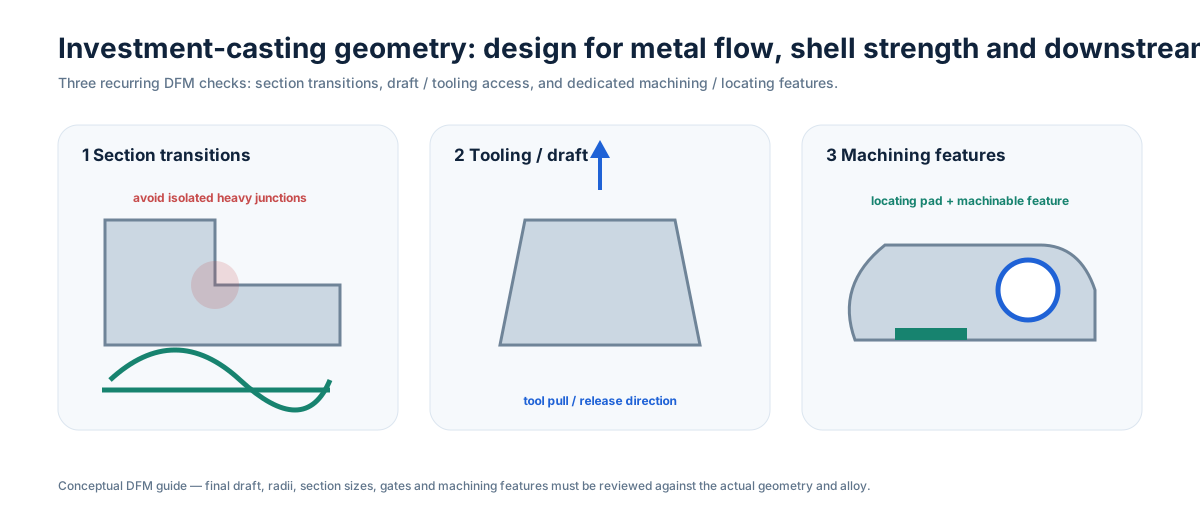
Review section transitions and metal flow
Uniform sections are easier to fill and cool consistently than isolated heavy junctions connected to thin walls. Where the function permits, use radii and gradual transitions rather than abrupt thickness changes. This does not mean every wall must be identical; it means the local geometry should be reviewed for flow length, hot spots, shell strength and feeding.
Deep pockets, blind cavities and long internal passages also affect wax tooling, shell building, dewaxing and ceramic removal. The best geometry is the one that can be produced and cleaned repeatably, not merely drawn.
Consider tooling direction, draft and cut-off
Wax patterns must release from the tooling unless soluble cores, ceramic cores or more complex tooling strategies are justified. Draft, parting direction and core strategy should be evaluated before the drawing becomes too rigid. Gate and runner locations also need areas that can later be cut and blended without damaging functional surfaces.
Allocate precision where it creates value
Sealing faces, bores, bearing locations, threads and critical datums are common machining candidates. Other geometry can often remain as-cast. A drawing that distinguishes functional machined dimensions from controlled as-cast dimensions gives the supplier more freedom to build a stable route.
If CNC machining follows casting, include usable locating pads and enough local stock to establish the first setup. See Designing Castings for CNC Machining and Machining Allowance when planning the cast-to-machine transition.
Design the inspection route at the same time
Critical characteristics should have an identifiable measurement method and datum scheme. If a feature is difficult to reach with the machining tool, it may also be difficult to inspect. Pressure boundaries, material verification, NDT and surface requirements should likewise be tied to the actual service risk rather than added as generic paperwork.
RFQ takeaway
Provide the native 3D model, controlled drawing, alloy or service condition, annual volume and critical requirements. DFM is most effective before tooling, when geometry, machining, inspection and finishing can still be optimized together.