
Design the first setup before the tooling is frozen
A casting that will be machined should arrive at the machine with a repeatable way to locate, clamp and inspect it. If the first setup has to find datums on irregular cast surfaces, the supplier may need extra stock, more probing, more fixtures and additional operations.
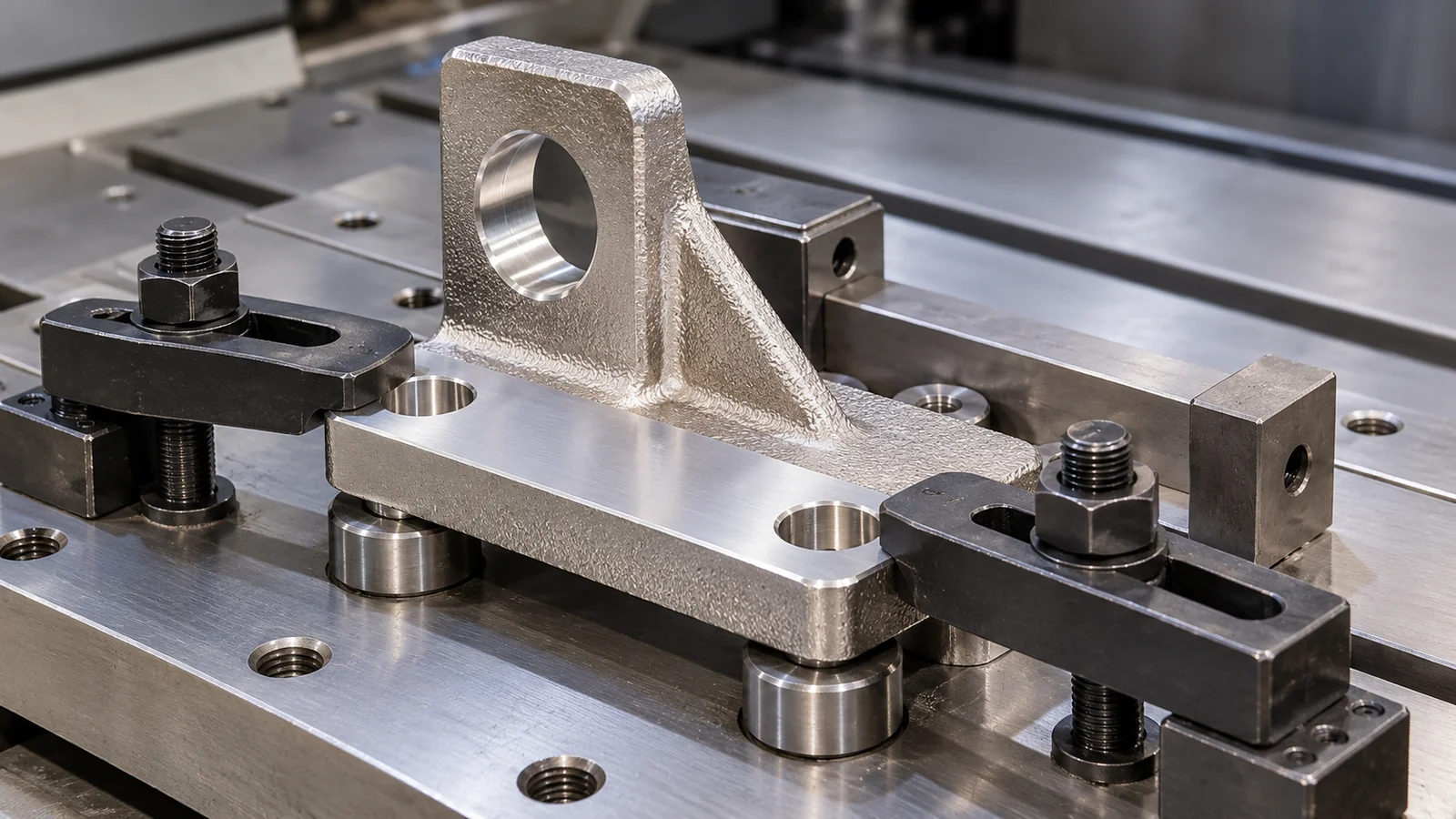
Give the fixture trustworthy locating features
Purpose-designed pads, bosses or sacrificial features can establish the first datum without forcing a functional surface to do two jobs. Their position should consider casting variation, draft, cut-off, heat-treatment movement and accessibility for both machining and inspection.
A stable datum chain is especially important when several machined features must relate to each other: concentric bores, seal faces, bearing seats, bolt patterns or rotating geometry. Those relationships are usually more robust when produced and checked from a common machining strategy rather than dimensioned independently from unrelated as-cast surfaces.
Plan clamp access and distortion
The fixture must hold the part firmly without distorting thin walls or open sections. Clamp pads need enough area and stiffness, and the cutting sequence should avoid releasing large amounts of residual stress in one operation. For flexible components, roughing, stress relief or heat treatment, and final finishing may need to be sequenced deliberately.
The model should also leave tool access for cutters, drills, probes and deburring tools. A feature that is geometrically machinable may still be expensive if the tool approach forces long overhang, special angle heads or repeated re-clamping.
Connect machining datums to CMM inspection
Before releasing casting tooling, define the first-setup locating pads and the finished datum reference frame. A machined bore inspected against a different as-cast reference may pass one setup yet fail assembly. ISO 1101:2017 defines geometric specification symbols and interpretation, not proof of workholding repeatability. Ask for a first-article plan connecting initial fixturing to final CMM features.
Whenever possible, the inspection datum scheme should reflect how the part is manufactured and how it functions in assembly. That reduces disagreements between machine setup, CMM programming and customer inspection. It also makes it clearer which dimensions are controlled by casting and which are created by machining.
RFQ takeaway
Send the finished 3D model and controlled drawing, and identify the few interfaces that govern assembly, sealing, rotation or alignment. During DFM we can review locating pads, machining stock, workholding, operation sequence and inspection datums as one route.
Engineering decision checkpoint for OEM buyers
Before freezing investment-casting tooling, mark which surfaces will be machined, how the raw casting will be located and clamped, and where stock must survive distortion and casting variation. For pressure-containing geometry, agree how machining-exposed discontinuities and final leak acceptance will be evaluated.
Related technical or project evidence: Porosity & Pressure Tightness | Complex Flow Housing
For sourcing after datum and fixture planning, compare a complete cast-to-finished-part quotation under fully machined castings rather than pricing an unmachined casting alone.
Engineering design-review route
No universal production limit or acceptance value is implied. Verify the actual drawing, alloy, process route and relevant purchase standard.