
Start with the finished part, not a preferred process
Investment casting, forging, CNC machining from wrought stock, metal injection molding (MIM) and high-pressure die casting solve different manufacturing problems. The most useful question is not “Which process is better?” but which route creates the required finished geometry, properties and quality evidence with the least total cost and risk at the expected volume.
The same drawing can also move between routes over its life. A new product may start as CNC-machined billet, move to a near-net-shape casting after geometry stabilizes, and still retain CNC machining on datums, bores, threads and sealing surfaces.
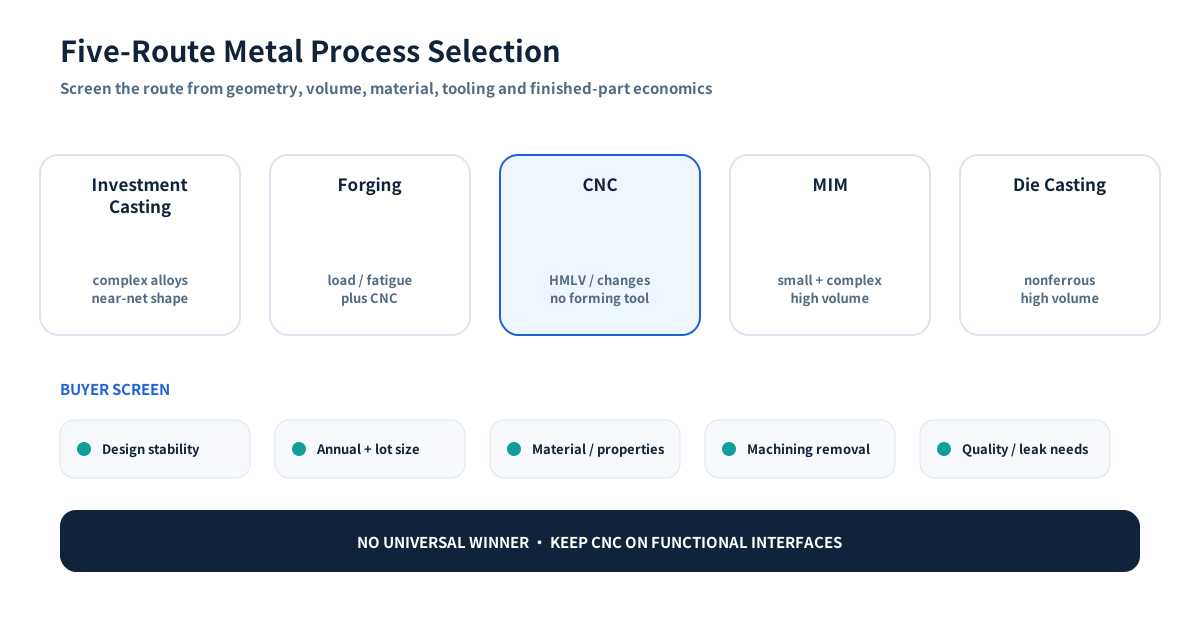
Five-process buyer matrix
| Route | Often a strong fit when | Tooling profile | Volume logic | Main buyer caution |
|---|---|---|---|---|
| Investment casting | Complex stainless/alloy geometry, integrated bosses, flow bodies, near-net shape | Dedicated wax/tooling and process development | Repeat low-to-medium and medium volumes can justify tooling when machining is reduced | Do not force casting tolerances onto every feature; plan finish machining and pressure-critical zones |
| Forging + CNC | High structural loading, fatigue-sensitive parts, simpler shapes where forged properties matter | Dedicated dies/fixtures in many programs | Usually improves as repeat demand rises | Complex geometry may still require heavy machining; forging is not automatically superior for every part |
| CNC from wrought stock | Prototypes, HMLV programs, frequent revisions, accessible geometry | Little or no dedicated forming tooling | Excellent at low volume; economics decline as material removal and cycle time grow | Expensive alloys, deep pockets and large buy-to-fly ratios can make full machining inefficient |
| MIM | Small, complex metal parts with many repeated features and high production demand | High tooling and process-qualification commitment | Strongest when substantial volume amortizes tooling and sintering development | Size, section thickness, shrinkage control, feedstock/alloy availability and qualification must fit the part |
| Die casting | High-volume nonferrous housings, covers and structural shapes | High-cost production dies and process development | Designed for high throughput once the design is stable | Alloy family, porosity, heat-treatment route, pressure tightness and post-machining requirements need early review |
The matrix is a screening tool, not a quotation formula. Part size, alloy, tolerance, annual demand, batch size, tooling life, automation and inspection can shift the economic boundary substantially.
Investment casting: complexity and alloy flexibility
Investment casting is attractive when complex geometry can replace machining or assembly. Curved flow paths, multiple boss directions, mounting features and irregular stainless or alloy-steel bodies can often be brought close to final shape in one casting.
Its value is strongest when the casting removes enough machining or weldment complexity to justify tooling and process development. Tight bores, bearing seats, threads, gasket faces and precision datums are still commonly machined. The Investment Casting Institute similarly emphasizes shape flexibility while warning against specifying unnecessarily tight casting tolerances.
Investment casting is therefore not “precision machining without machining.” It is a near-net-shape starting route that can place material where the finished part needs it.
Forging: use it when the load path justifies it
Forging can be the better starting form when the drawing and service condition genuinely benefit from forged material flow, high structural loading or fatigue performance. Shafts, highly loaded links, some pressure parts and safety-critical mechanical components can fit this logic.
But a forged blank that requires extensive 5-axis machining may lose much of its commercial advantage. Buyers should compare the finished forging + machining route against a casting or billet route rather than comparing raw blanks.
A drawing or customer specification may also mandate forged/wrought material. When that is the case, process selection is already constrained and should be treated as a technical requirement, not a cost preference.
CNC machining: the natural route for prototypes and HMLV
CNC machining from bar, plate or billet has one major commercial advantage: design freedom without dedicated forming tooling. That makes it especially effective for prototypes, service parts, early production, high-mix low-volume programs and products still going through engineering revisions.
It becomes less attractive when:
- the starting block is much larger than the finished part;
- expensive stainless, duplex or nickel alloy is removed as chips;
- long tool paths dominate cycle time;
- deep internal geometry is difficult to access;
- annual demand becomes large enough to amortize near-net-shape tooling.
The correct comparison is not machining hourly rate alone. Material yield, tooling, setup, number of operations, workholding, inspection and revision frequency all matter.
MIM: excellent for the right small, repeated part
Metal injection molding combines fine metal powder with an injection-molding style forming step, followed by debinding and sintering. The Metal Powder Industries Federation describes MIM as a route for complex shapes in large quantities with high production rates and near-net-shape capability.
That makes MIM compelling for small, intricate, repeated components where a multi-cavity tool can replace many machining operations. It is usually less attractive for large industrial housings, low annual quantities or parts whose geometry changes often.
Buyers should qualify:
- available alloy and required properties;
- part size and section transitions;
- dimensional change through debinding/sintering;
- tool-cavity strategy and expected lifetime;
- secondary sizing, heat treatment or machining;
- inspection and capability evidence after the process is stable.
MIM is not simply “small investment casting.” The feedstock, shrinkage, sintering and tooling economics are fundamentally different.
Die casting: high throughput after design freeze
High-pressure die casting is strongest for stable, high-volume nonferrous components such as aluminum, zinc or magnesium housings and structural shapes. NADCA highlights design needs such as uniform wall thickness, draft, fillets, metal flow, venting and thermal control.
The commercial trade-off is clear: sophisticated dies and process development can support very high throughput, but they make frequent design changes expensive. Pressure tightness, heat-treatment requirements and machining through potentially porous regions need to be reviewed before tooling is frozen.
For a buyer, “die cast” should therefore trigger questions about alloy, design maturity, annual volume, die life, leak requirements and post-machining, not just piece price.
A practical decision sequence
1. Is the design still changing?
If yes, CNC usually deserves serious consideration. Tooling-heavy routes become more attractive after geometry and interfaces stabilize.
2. Is the part small, intricate and genuinely high volume?
MIM can become compelling when many tiny features are repeated in large quantities and the material system is suitable.
3. Is the part a stable high-volume nonferrous housing or structure?
Die casting may provide the best throughput if the geometry, alloy and quality requirements fit the process.
4. Are forged properties or a wrought-material specification important?
Forging may be the correct starting route, followed by CNC where final precision is required.
5. Can complex stainless/alloy geometry eliminate major machining or assembly?
Investment casting can be attractive when near-net shape creates a real finished-cost advantage.
6. Which surfaces actually need precision machining?
Regardless of the starting route, keep CNC on the functional features that control sealing, bearing fits, alignment, threads and inspection datums.
Why HMLV changes the answer
High-mix, low-volume procurement has different economics from a single stable mass-production SKU. Tooling changeovers, revision control, fixture storage, first-piece verification and small-lot scheduling can matter more than theoretical cycle time.
For an HMLV portfolio, it may be rational to use:
- CNC for low-demand or frequently changing parts;
- investment casting + CNC for repeat complex stainless/alloy parts;
- forging + CNC where properties require it;
- MIM or die casting only after selected part numbers reach stable, tool-worthy volume.
A supplier that can manage several routes does not remove the need for process discipline; it should make it easier to challenge an unsuitable starting process.
RFQ takeaway
For a process comparison, send the finished drawing and 3D model, material requirement, annual demand, expected lot size, program life, critical properties, machined features, pressure/leak requirements and inspection scope. Those inputs allow the manufacturing route to be evaluated from finished-part economics instead of forcing a raw-material process too early.