
What buyers are typically sourcing
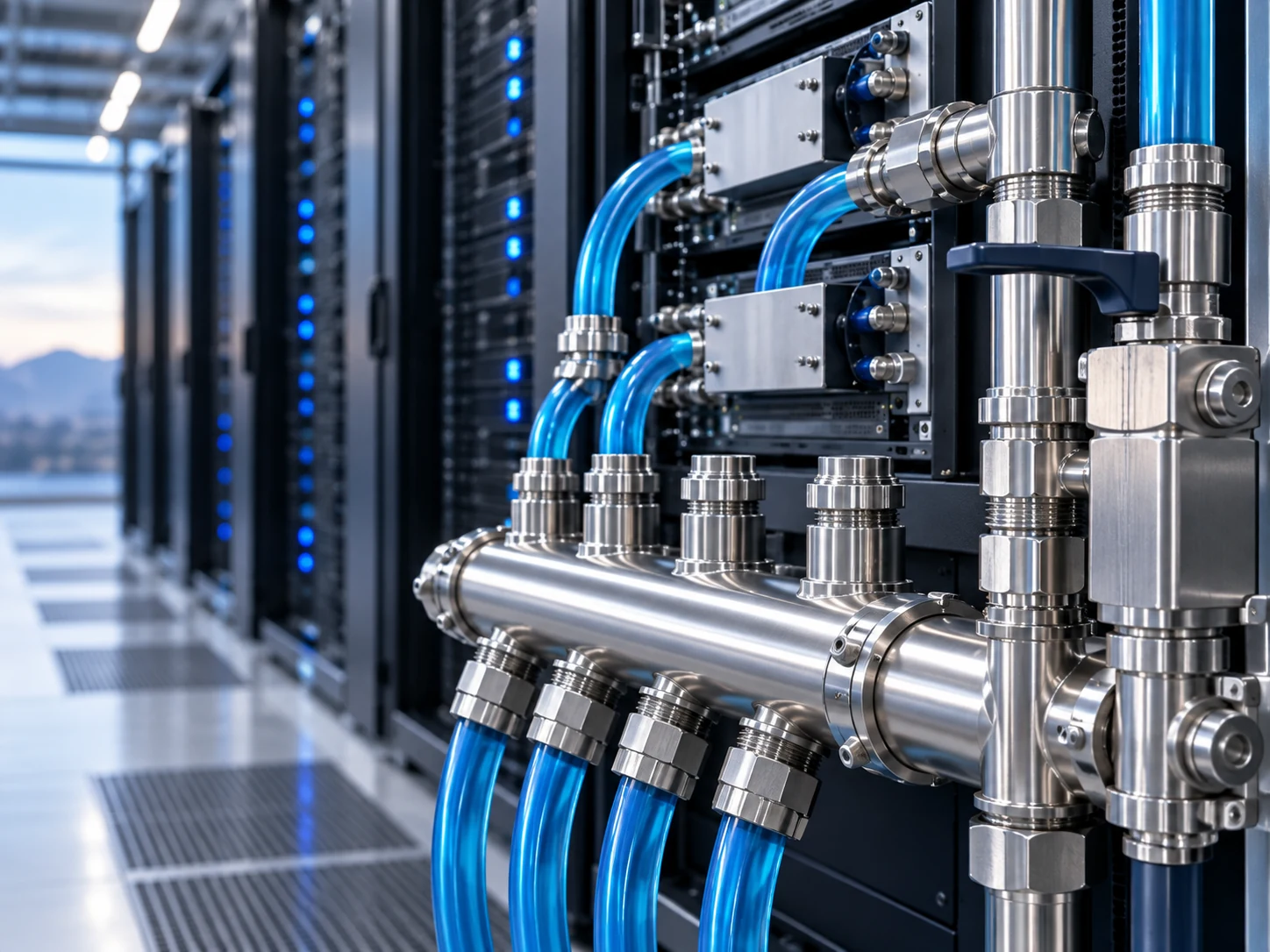
Liquid-cooling hardware creates a wet-side supply chain around coolant distribution units (CDUs), pumps, valves, strainers, manifolds, adapters, fittings, couplings and pressure housings. Our role is not to supply the complete cooling system. We manufacture the metal components where near-net casting, precision CNC machining, finishing and verification can reduce finished-part complexity for the OEM or subsystem supplier.
Component opportunities
- CDU fluid circuit: valve bodies, strainer bodies, pump housings, covers, adapters and other pressure-containing flow parts
- Pumps: housings, casings, impellers, diffusers, covers and machined interfaces
- Valves & strainers: bodies, bonnets, balls, stems, end connections and Y-strainer bodies
- Manifolds & distribution blocks: multi-port bodies and distribution hardware where geometry or repeat volume justifies a cast-to-machine route
- Adapters, fittings, couplings & connectors: complex stainless or duplex bodies with machined threads, sealing lands and connection interfaces
For simple prototypes or low-volume blocks, machining from billet may still be the better route. We review the finished drawing first rather than forcing every part into investment casting.
Why cast + CNC can fit liquid-cooling programs
The useful candidates usually combine several needs at once: corrosion-resistant material, complex flow geometry, pressure integrity, multiple bosses or ports, and critical machined sealing interfaces. Investment casting can bring the blank close to net shape; CNC machining then establishes bores, threads, O-ring lands, gasket faces, seats, sensor ports and assembly datums.
This is especially relevant when a buyer wants a fully machined component instead of managing a foundry and machine shop separately.
Procurement priorities for wet-end components
Pressure and leakage
Define design pressure, test pressure, test medium, hold time and allowable leakage. Pressure tightness depends on casting quality, machining location, seal geometry and the final verification plan — not on a final test alone.
Material and coolant compatibility
Specify the coolant or service environment and the governing material standard. Depending on the design, buyers may evaluate CF8M/316, CF3M/316L, duplex 2205 or another alloy family. The correct choice belongs to the product specification, not to the AI label.
Cleanliness and finished surfaces
Deburring, flushing, cleaning, drying and packaging can matter where particles could enter pumps, valves, cold plates or small flow passages. Identify any passivation, electropolishing, roughness or cleanliness requirement in the RFQ.
Revision control and HMLV supply
Liquid-cooling programs can move through prototype, pilot and ramp stages with multiple part numbers and revisions. We support high-mix, low-volume production where smaller repeat lots, controlled revisions and different casting / machining / finishing routes must coexist.
Second-source and repeat-program support
For established designs, we can review an existing drawing as a second source / alternate source, including the current material, annual demand, inspection plan and target cost structure. For repeat programs, blanket orders, scheduled releases and VMI, safety stock, Kanban and JIT programs can be evaluated where local inventory or forecast-based replenishment reduces supply risk.
What to send for quotation
- Controlled 2D drawing and 3D model
- Material grade and governing standard
- Coolant / service environment
- Design and test pressure plus leakage criterion
- Pilot quantity, annual demand and expected release size
- Critical sealing surfaces, threads, bores and datums
- Cleanliness, passivation / electropolishing and packaging requirements
- NDT, dimensional, material and traceability requirements
- Current supplier benchmark or second-source objective, if applicable
If the part is still at prototype stage, include the expected path from pilot quantity to repeat demand so we can compare billet machining against a cast-to-machine route.