
Build the RFQ around the finished part
A useful RFQ gives engineering and purchasing enough information to choose a manufacturing route, identify the real risk drivers and quote the finished component rather than only the casting or machining step. It does not need unnecessary paperwork before the supplier understands the application.
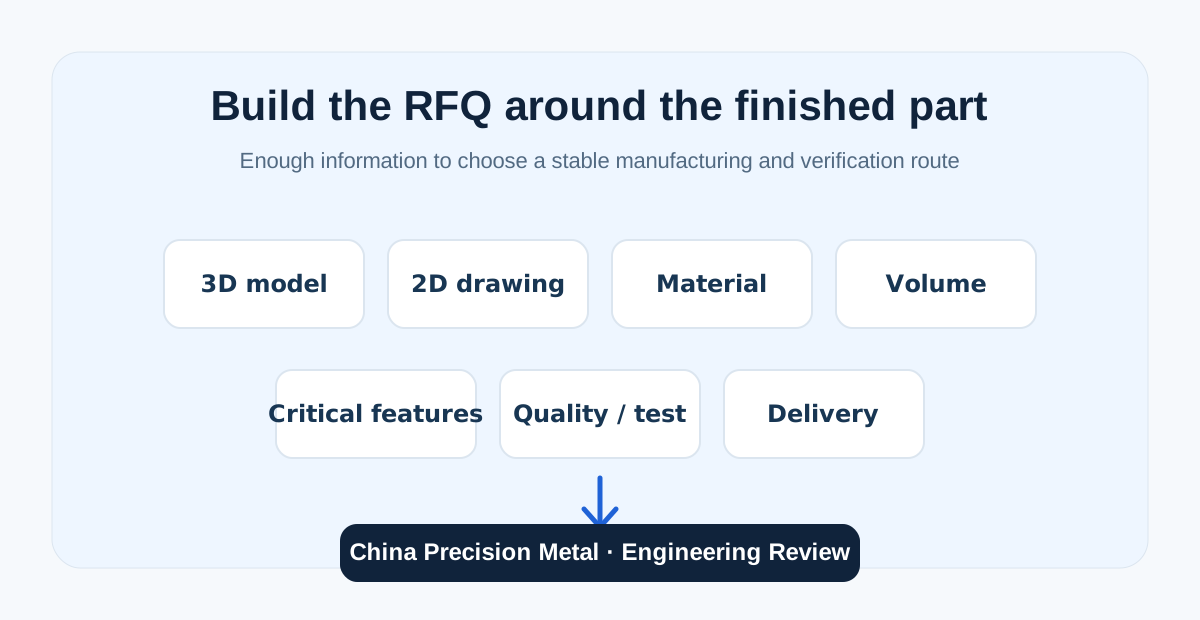
RFQ checklist: what to send
| Input | Minimum useful detail | Why it matters |
|---|---|---|
| Geometry | Native 3D model when available, plus the controlled 2D drawing and revision | The model supports DFM and tooling review; the drawing defines controlled dimensions, notes and acceptance requirements. |
| Material & service | Alloy/specification, heat-treatment condition and relevant medium, pressure, temperature or corrosion duty | Material and service conditions can change casting, heat treatment, machining, finishing and verification. |
| Quantity | Sample quantity, first order, typical batch and estimated annual volume | Quantity influences tooling, process choice, fixture strategy, inspection plan and finished-part economics. |
| Critical characteristics | Datums, tight dimensions, sealing/bearing features, threads and true must-hold requirements | The supplier can concentrate process capability and inspection where failure would matter. |
| Machining & finish | Machined surfaces, roughness parameter/value, polishing, passivation, electropolishing or coating | Prevents quoting an incomplete finished route or adding unnecessary finishing to nonfunctional areas. |
| Quality & testing | Material certificate, FAI/PPAP, Cpk, NDT, pressure/leak test and traceability when required | Verification should be planned with the manufacturing route, not added after pricing. |
| Delivery & supply model | Required sample date, normal production target, ship-to location, packaging and, if relevant, VMI, blanket order, stock-and-release, Kanban or JIT | Separates one-time urgency from the recurring supply model and exposes inventory/replenishment rules early. |
The downloadable RFQ Data Sheet separates project inputs, critical characteristics, quality/testing requirements and file references into five worksheets. For repeat programs, also state the expected supply model—such as VMI, blanket order, stock-and-release, Kanban, safety stock or JIT—where relevant. Fill only the sections that apply to the project.
Investment casting DFM checklist
Use the following review before tooling is frozen:
- Function first. Identify pressure boundaries, flow paths, sealing faces, bearing seats, cosmetic zones and assembly interfaces.
- Section transitions. Review isolated heavy sections, abrupt thickness changes and long thin flow paths. Where function permits, use radii and gradual transitions rather than sharp changes.
- Tooling and cores. Check wax-pattern release, parting direction, draft, deep blind features, internal passages and whether soluble or ceramic cores are justified.
- Gate and cut-off access. Keep functional surfaces away from likely gate/runner cut-off areas where practical and allow access for cut-off and blending.
- Machining strategy. Define cast versus machined surfaces, first-setup datums, workholding pads and local stock on critical features.
- Inspection access. Make critical features measurable from a workable datum scheme and decide how hidden or internal features will be verified.
- Pressure and NDT. Tie pressure/leak testing and nondestructive examination to the actual service risk and drawing requirements rather than applying generic inspection everywhere.
- Commercial fit. Evaluate tooling, quantity, machining reduction, material utilization, finishing and inspection together as finished-part cost.
Process selection worksheet: investment casting vs CNC vs forging
Start with the finished-part requirement, not a preferred process. The table below is a screening worksheet for deciding which route deserves a detailed DFM and cost review; it is not a substitute for drawing, material and service validation.
| Decision factor | Investment casting | CNC from wrought stock | Forging + machining |
|---|---|---|---|
| Complex external geometry | Often strong when near-net shape removes substantial machining | Strong for low volume or geometry that is easy to reach with tools; material removal can become expensive as complexity rises | Best when the forged preform can remain comparatively simple; complex detail is usually added by machining |
| Internal passages / hard-to-machine features | Can be attractive when core design and casting access are feasible | Limited by tool access unless the feature can be drilled, bored, EDM'd or split into multiple parts | Generally not suited to enclosed complex internal passages in the forged preform |
| Prototype urgency / design still changing | Tooling and process development usually make it slower to start | Often the fastest production-material route for low quantities and changing geometry | Die/tooling development usually makes it less attractive before the design is stable |
| Repeating volume & material utilization | Often improves as repeat volume justifies tooling and near-net geometry reduces machining/scrap | Attractive at low volume; economics can weaken when large amounts of costly alloy are removed repeatedly | Can be strong at sustained volume when the geometry and required properties suit the forging route |
| Mechanical-property driver | Suitable for many industrial components when alloy, heat treatment, casting quality and acceptance requirements are appropriate | Retains the properties of the selected wrought stock, subject to machining direction and final geometry | Often favored when specification, fatigue/impact duty or directional grain flow makes the forging route important |
| Tight tolerances / sealing / bearing features | Critical features are commonly finish-machined after casting | Direct machining gives strong control of accessible critical features | Critical features are commonly finish-machined after forging |
| Tooling investment / change risk | Tooling is normally required; design changes after tooling should be controlled | No casting/forging die, so design changes are comparatively easy | Production tooling/dies can be significant and favor a stable design |
| Pressure-tight duty | Process choice alone does not guarantee leak-tightness; design, foundry control, machining and specified leak/pressure verification remain decisive | Dense wrought stock may simplify the starting-material risk, but final sealing still depends on design and machining | Dense forged stock may simplify the starting-material risk, but final sealing still depends on design and machining |
A practical screening sequence
- Rule out non-negotiable constraints first: material specification, required properties, code/customer requirements and service risk.
- Compare finished-part economics, not raw-process price: tooling, material yield, machining hours, fixtures, finishing, inspection and recurring volume belong in the same comparison.
- Use CNC as a useful benchmark: even when it is not the long-term route, machining from stock can expose the value of near-net shaping and can be the correct route for urgent prototypes or low volume.
- Keep critical features process-neutral: sealing faces, bearing seats, threads and tight datums may still need machining regardless of the starting process.
- Validate before conversion: changing forging, casting or wrought-machining routes should be confirmed against the controlled drawing and actual service requirements.
A real example of this review is our Danish forging-to-investment-casting case, where the route was changed only after technical feasibility was confirmed and the customer reported approximately 30% lower component cost.
What a supplier-ready package looks like
Useful: controlled 2D drawing + material + quantity. Enough for initial process and commercial screening.
Better: native 3D + controlled 2D + annual volume + critical dimensions + finish requirements. This supports faster DFM and a more reliable route definition.
Best: the above plus service conditions, quality/test requirements, target dates, packaging and logistics. This reduces clarification loops and makes the quotation closer to the real production program.
Downloads
The checklist is a scoping aid. The controlled drawing, specifications and agreed project requirements remain the governing acceptance documents.