
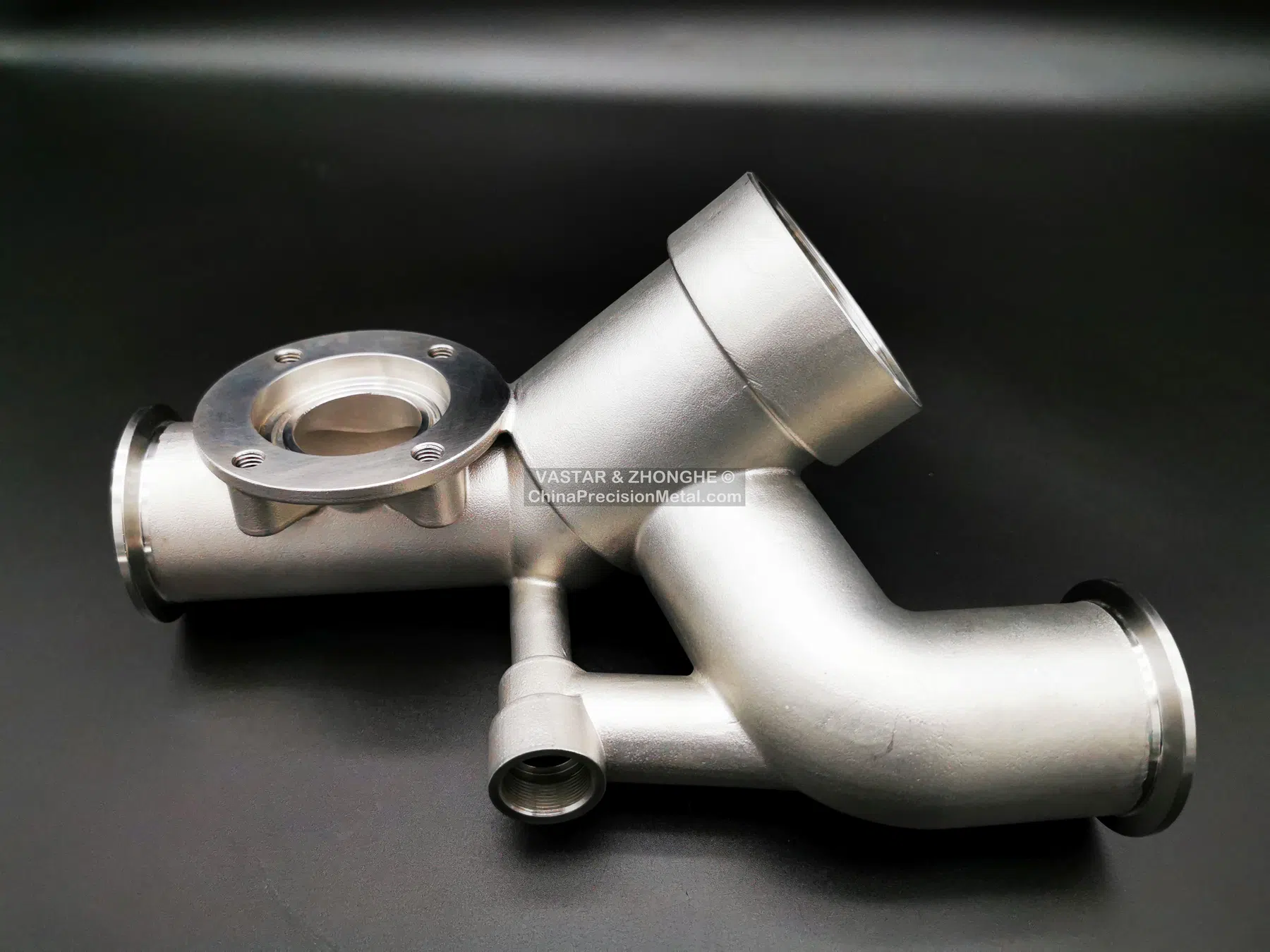
Component challenge
A complex flow housing combines near-net-shape passages with machined ports, bores, faces and sealing features. The parts in our existing product portfolio show the type of geometry for which investment casting can replace a multi-piece fabrication or reduce extensive machining from solid.
The purchasing risk is not only whether the external shape can be cast. Wall transitions, isolated heavy sections, internal junctions and the depth of subsequent machining all influence feeding, porosity risk and final pressure integrity.
Process planning priorities
- Orient the wax pattern and gating so critical pressure-boundary zones receive stable feeding.
- Maintain practical wall transitions around passage intersections and bosses.
- Reserve controlled machining stock without removing more cast skin than necessary.
- Define datums that can be found repeatably on an irregular casting.
- Separate cosmetic surfaces from sealing, bearing and threaded features.
Machining and inspection
Ports and sealing faces are normally machined after heat treatment and cleaning. The operation sequence should control distortion while preserving access for clamping and measurement. CMM inspection can verify port location, bore relationships and machined datums. Penetrant or other NDT can be assigned to relevant pressure-boundary zones.
Where leakage performance is required, the test should be performed after the machining and cleaning steps that represent the delivered condition. Hydrostatic or pneumatic testing is selected according to the specification and service requirement.
Useful RFQ information
Send the 3D model, pressure boundary, test pressure, leakage criterion, material standard, repair restrictions, annual quantity and critical machined features. These inputs allow casting, machining and testing to be quoted as one route.