
Robotics is a machining opportunity first — casting only where it fits
Humanoid robots combine electric motors, reducers, bearings, sensors, batteries, structural frames, joint housings, brackets, shafts, end-effectors and many precision interfaces. That creates real demand for metal manufacturing, but it does not mean every robot is a large investment-casting opportunity.
The strongest near-term fit for a high-mix industrial supplier is usually CNC machining, prototype/pilot manufacturing and selective conversion to near-net-shape routes after designs stabilize.
What the 2026 supply-chain data says
McKinsey's April 2026 humanoid supply-chain analysis estimates that actuators represent roughly 40–60% of the humanoid bill of materials, while structural components such as frames, joint housings, brackets and enclosures represent around 5–10%. Within an actuator, mechanical components such as structural casings, shafts and precision bearings are also a meaningful cost block.
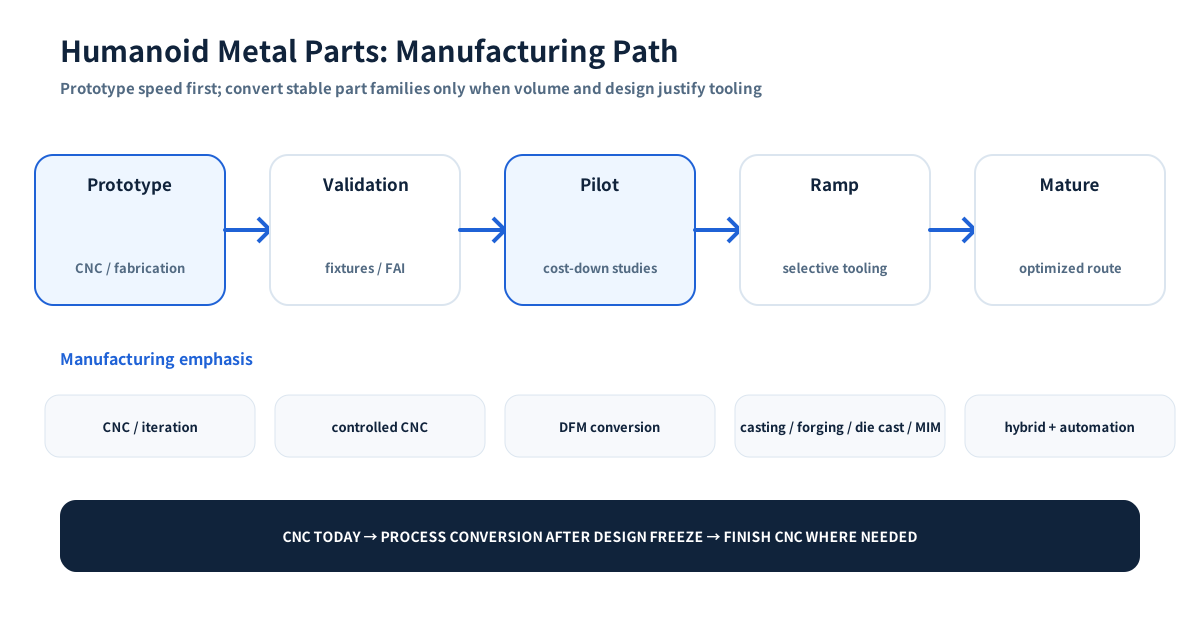
More important for manufacturing strategy, McKinsey describes today's humanoid structural parts as still relying heavily on CNC machining, low-volume fabrication and custom assembly because architectures are changing quickly and production volumes remain uncertain. It also expects tooling-intensive routes such as die casting or forging to become more attractive after designs and interfaces converge. Source.
The International Federation of Robotics reports that China already has around two million industrial robots in operation and accounted for 54% of annual industrial-robot installations in the latest World Robotics data cited in 2026. That existing automation, EV and precision-motion ecosystem matters because humanoid hardware draws on many adjacent manufacturing capabilities.
Metal component opportunities inside a humanoid
The exact architecture varies by OEM, but common metal-manufacturing opportunities include:
Actuator and joint hardware
- actuator housings and covers;
- motor / reducer interfaces;
- shafts, pins and bearing seats;
- joint housings and structural brackets;
- precision bores, threaded features and mounting datums;
- heat-dissipation and protective metal interfaces.
These parts are often tolerance-stack sensitive. Bearing fits, gear alignment, runout, coaxiality and rigidity can be more important than cosmetic finish.
Frames, links and structural interfaces
Frames, arms, links, brackets and enclosures need a balance of stiffness, weight, fatigue performance and manufacturability. Early versions are often machined or fabricated because geometry is still changing. At larger stable volumes, aluminum die casting, forging, extrusion, sheet structures or composites may become more economical depending on load and weight.
Hands, grippers and end-effectors
Hands and end-effectors can contain many small brackets, fingers, joints, shafts, housings, tool interfaces and wear components. These may remain relatively high-mix because task-specific end effectors vary by application.
This is one area where small-batch CNC and selective stainless/alloy near-net-shape parts can remain relevant even if the robot's main frame eventually moves to a high-volume process.
Thermal and fluid-control parts
Robots can also use compact cooling plates, fluid manifolds, pump/valve hardware or sealed enclosures depending on power density and application. These are ordinary thermal/fluid engineering problems rather than “robot-only” parts and should be sourced by pressure, cleanliness, material and leak requirements.
Why CNC is so important during prototype and pilot stages
Humanoid development is still characterized by rapid iteration. A joint housing may change when the reducer, motor, bearing, sensor or cable routing changes. Dedicated production tooling becomes a liability if the interface changes before the next build.
CNC supports this stage because it offers:
- fast design revisions without new forming tools;
- direct conversion from released CAD to prototype/pilot hardware;
- broad access to aluminum, stainless steel, alloy steel, titanium and engineering plastics;
- accurate datums for tolerance-stack testing;
- easy comparison of multiple design variants;
- practical production of dozens of part numbers in small lots.
That is a natural high-mix, low-volume environment.
When investment casting can fit — selectively
Investment casting should not be marketed as the default process for humanoid structures. Lightweight aluminum frames and large structural housings are often better candidates for CNC, die casting, forging, extrusion or fabricated structures.
Investment casting can become interesting where all of these conditions align:
- stainless steel, alloy steel or another castable alloy is functionally appropriate;
- geometry is complex enough to consolidate several machined/welded features;
- annual demand is repeatable enough to justify tooling;
- the part benefits from near-net shape more than from ultralight sheet/extruded geometry;
- finish machining can be concentrated on bearing seats, interfaces and datums.
Potential examples include compact complex housings, end-effector parts, harsh-environment brackets, selected actuator/gearbox structures and pump/valve components used by robotic subsystems. Each still needs part-specific DFM.
What happens after design freeze
As a robot architecture matures, purchasing should re-open the make-process decision instead of automatically scaling the prototype route.
A practical conversion review asks:
- Which part numbers are stable for the next several revisions?
- Which parts now have predictable multiyear demand?
- How much material is CNC removing from each billet?
- Which tolerances are truly functional, and which can move to the near-net process?
- Is lightweighting more important than material/yield cost?
- Does the load path favor forging, casting, extrusion or a fabricated structure?
- Can MIM replace machining for small repeated hardware?
- Can die casting justify the tooling for stable nonferrous housings?
The goal is not to eliminate CNC. It is to move precision machining to the interfaces where it adds value.
A stage-gated manufacturing model
| Development stage | Typical sourcing need | Likely manufacturing emphasis |
|---|---|---|
| Concept / prototype | Speed, geometry learning, frequent changes | CNC, additive aids, low-volume fabrication |
| Engineering validation | Repeatable datums, fit, load testing, small batches | CNC with controlled fixtures and inspection |
| Pilot / pre-series | Stable revisions, cost-down, supplier qualification | CNC plus first near-net-shape conversion studies |
| Ramp | Repeatable volume, capability evidence, tool readiness | Mix of CNC, casting, forging, die casting, MIM depending on part family |
| Mature platform | Cost, automation, capacity, dual-source resilience | Tooling-intensive routes for stable parts; CNC retained on critical interfaces |
A robot can sit in more than one stage at once: the torso may be stable while the hand, sensor bracket or end-effector changes every few weeks.
Quality priorities are different from “ordinary machine parts” only in degree
Humanoid components do not need a mystical new quality system. They need disciplined execution around the functions that matter:
- GD&T and datum structure aligned with joint assembly;
- bearing fits and shaft/bore geometry;
- runout and coaxiality for rotating systems;
- burr and sharp-edge control around cables and seals;
- material/heat-treatment traceability where structurally important;
- first-article inspection during rapid revision cycles;
- capability studies after a process is stable enough for Cpk to be meaningful;
- documented change control when a motor, bearing or reducer interface changes.
For HMLV pilot programs, revision control can be as important as machine capability. A perfectly machined obsolete revision is still a bad part.
Where a China-based HMLV supplier can be useful
China's dense robotics, EV, machining and electromechanical supply base can shorten iteration loops for hardware teams, but the sourcing decision still has to consider IP, logistics, export controls, data/security requirements and regional resilience.
The best fit is often component-level manufacturing, where the buyer controls the design and needs reliable machining/casting, inspection and revision execution across many part numbers—not a supplier claiming to “build humanoid robots.”
RFQ takeaway
For robot metal parts, send the released drawing/model, revision status, material, prototype/pilot/production stage, expected lot and annual demand, critical datums/fits, surface/weight constraints, inspection scope and expected revision cadence. If the design is stable enough, ask the supplier to compare CNC-only versus near-net-shape + finish machining rather than scaling the prototype process automatically.