
AI heat is becoming a mechanical supply-chain issue
The rapid build-out of AI and high-performance-computing infrastructure is increasing rack heat density and accelerating the move from air cooling toward direct liquid cooling. The Open Compute Project maintains active workstreams for both coolant distribution units (CDUs) and cold plates, while 2026 reference designs from Schneider Electric describe AI clusters using liquid-to-liquid and liquid-to-air CDUs. Danfoss and Vertiv now publish dedicated CDU component portfolios that include pumps, valves, strainers, heat exchangers, filtration and controls.
That makes liquid cooling more than an electronics topic. It creates a growing mechanical ecosystem of pressure boundaries, flow-control hardware, rotating parts, fittings, housings and machined sealing interfaces.
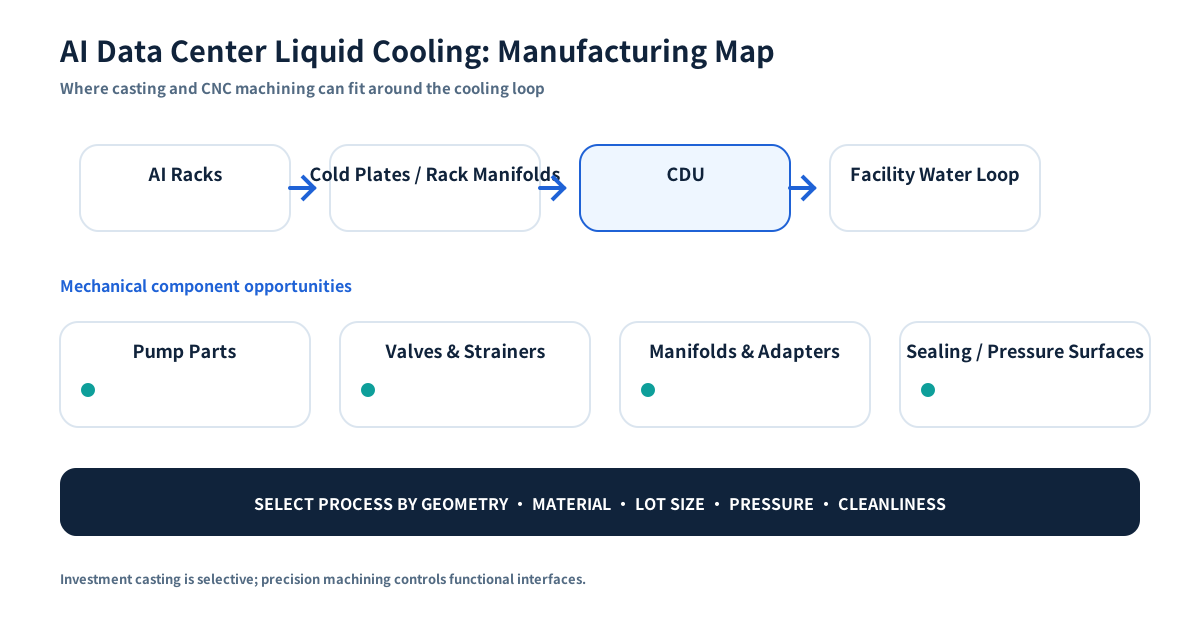
Where cast and machined metal parts can appear
Not every liquid-cooling component should be investment cast, and not every wetted component should be stainless steel. The correct process depends on geometry, material, pressure, cleanliness, volume and the OEM design. The useful question is where near-net shaping or precision machining can reduce total finished cost without weakening reliability.
| Liquid-cooling area | Typical metal-component opportunities | Manufacturing fit |
|---|---|---|
| CDU fluid circuit | Valve bodies, strainers, pump components, housings, adapters, covers | Investment casting can suit complex stainless/alloy flow bodies; CNC controls bores, threads, seal faces and datums |
| Pumps | Housings, impellers, diffusers, covers, shafts | Cast + machined routes can reduce material removal for complex flow geometry; shafts and simple forms may be better machined or forged |
| Valves & strainers | Bodies, bonnets, balls, stems, cages, strainers, end connections | Strong candidate area for cast stainless/duplex bodies plus finish machining and pressure verification |
| Manifolds & distribution blocks | Multi-port blocks, adapters, distribution bodies | CNC from billet is attractive for prototypes and low volume; casting becomes more relevant when geometry and repeat volume justify tooling |
| Quick-connect & hose hardware | Coupling bodies, sleeves, adapters, retainers | Often precision-machined or cold-formed; process selection depends heavily on leakage, wear and connection-cycle requirements |
| Sensor & instrument interfaces | Housings, bosses, adapters, protective bodies | Usually machining-intensive because threads, sealing features and instrument interfaces control function |
| Frames, brackets & enclosures | Structural supports and equipment hardware | Sheet metal, fabrication, extrusion, die casting or CNC may be more suitable than investment casting |
The point is not to force investment casting into an AI application. It is to identify components where complex flow geometry, corrosion-resistant alloys, part consolidation or reduced machining create a real reason to use it.
Why CDUs are especially relevant to metal-component suppliers
A CDU separates or manages the facility cooling loop and the technology cooling loop serving the IT equipment. Danfoss' 2026 CDU guidance identifies pressure-independent control valves, valves, strainers, heat exchangers, sensors, controllers and pump control as key parts of the system. Vertiv's CoolChip CDU range highlights redundant pumps and integrated filtration. Motivair by Schneider Electric announced a 2.5 MW CDU in January 2026 as liquid-cooling systems scale with next-generation AI infrastructure.
For a metal-component manufacturer, the opportunity is therefore concentrated in the fluid-handling hardware around the thermal system rather than in the silicon or server electronics.
Where investment casting can make sense
Investment casting is worth screening when a part has several of the following characteristics:
- complex external geometry or internal flow passages;
- stainless, duplex, heat-resistant or nickel-alloy requirements;
- multiple bosses, ports or mounting features that can be consolidated;
- substantial material removal if machined entirely from billet;
- pressure-boundary geometry that benefits from a near-net starting form;
- repeat demand sufficient to justify tooling and process qualification.
Valve bodies, compact flow housings, some pump bodies, impellers and complex adapters are typical examples where cast-to-machine manufacturing may be worth evaluating.
Where CNC machining matters most
Even when the blank is cast, the functional performance usually depends on machining. Liquid-cooling hardware can include:
- O-ring and gasket lands;
- threaded or flanged connections;
- valve seats and stem bores;
- bearing locations and shaft interfaces;
- sensor ports;
- flatness-critical mounting faces;
- controlled passages and datums;
- leak-test and assembly interfaces.
For prototypes, design validation and genuinely low-volume parts, CNC from bar, plate or billet may be the best route because it avoids tooling and accommodates engineering changes quickly.
High-mix, low-volume capability matters while architectures are still evolving
AI cooling systems are not a single frozen product architecture. Different GPU generations, rack layouts, coolant strategies, CDU capacities and customer standards create multiple variants. Early programs also move through prototype, pilot and ramp stages before stable high-volume demand is known.
That favors suppliers that can manage high-mix, low-volume (HMLV) work: many part numbers, controlled revisions, relatively small production lots and a mix of casting, machining, finishing and inspection routes. A supplier optimized only for long repetitive runs can be less flexible when a program is still changing.
For buyers, the useful capability is not simply "low MOQ." It is the ability to control drawings, tooling, fixtures, inspection plans and traceability across many smaller programs without losing repeatability.
Engineering priorities for liquid-cooling metal parts
1. Pressure integrity and leak performance
Leakage can damage high-value IT equipment, so pressure-boundary parts need more than a final pass/fail test. Casting porosity, machining location, seal geometry, thread quality and assembly condition all interact. Hydrostatic or pneumatic testing should be defined by the product requirement, with test pressure, medium, hold time and acceptance criteria stated explicitly.
2. Material and coolant compatibility
Water, glycol mixtures and formulated coolants can create different corrosion and compatibility requirements. Material grade, heat treatment, passivation, surface condition and any restrictions on repair or impregnation should be specified by the system designer.
3. Cleanliness
Particles left in a flow component can damage pumps, valves, cold plates or small passages. Deburring, flushing, cleaning, drying and packaging therefore belong in the manufacturing plan, not as an afterthought.
4. Machined sealing surfaces
A cast body can be acceptable while a machined seal face is not. Datum strategy, stock allowance, workholding and final surface requirements should be reviewed before tooling is released.
5. Traceability and change control
AI infrastructure is evolving quickly. Revision control, material traceability and first-article / inspection records become more important when multiple versions of a component are in production at the same time.
Buyer checklist for a liquid-cooling component RFQ
Include the information that changes the manufacturing route:
- controlled 2D drawing and 3D model;
- material grade and governing standard;
- coolant / service environment;
- design and test pressure;
- annual demand, pilot quantity and expected lot size;
- sealing surfaces and leakage criteria;
- cleanliness and packaging requirements;
- passivation, electropolishing or other surface treatment;
- NDT, dimensional and material-verification requirements;
- repair / impregnation policy and documentation scope.
What buyers should not assume
The AI label does not automatically make a part technically demanding, nor does it mean every liquid-cooling component should be stainless or investment cast. Cold plates may rely on brazing, machining or other thermal-manufacturing methods; manifolds may be more economical from billet at low volume; structural parts may belong in sheet metal or die casting.
A credible supplier should be willing to say when casting is not the right route.
Need a supplier page rather than a technical guide?
For a procurement-focused view of CDU, pump, valve, strainer, manifold, adapter and other wet-end metal components, see AI Data Center Liquid Cooling Components.
RFQ takeaway
For AI data-center liquid-cooling hardware, start with the finished component and service requirement. If the part combines complex flow geometry, corrosion-resistant material, pressure integrity and several machined interfaces, a cast + CNC + finishing + verification route may be worth comparing against machining from billet or another starting form.