
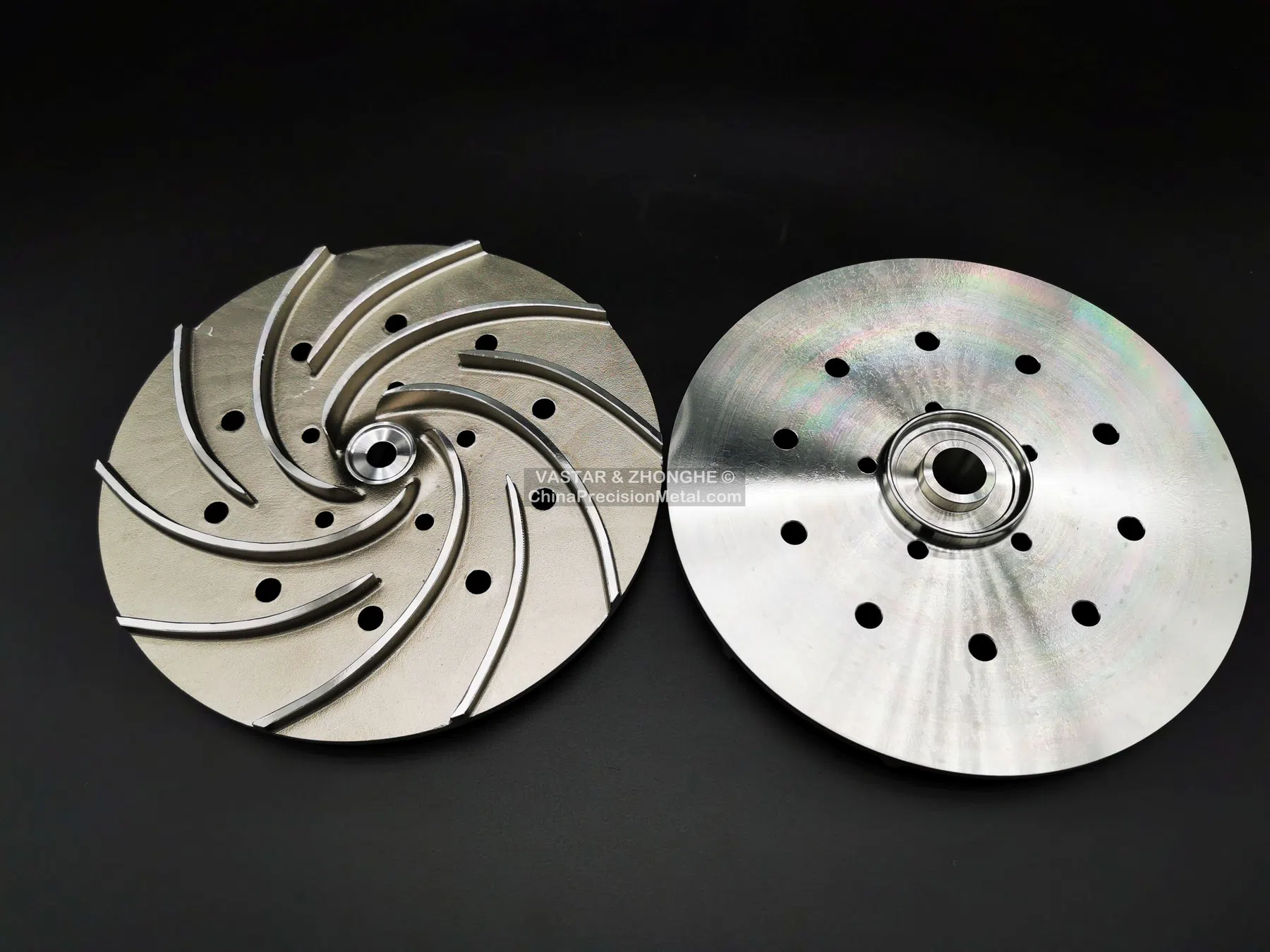
Component challenge
Impellers concentrate several requirements in one part: repeated blade geometry, open or enclosed flow passages, a central bore or hub, rotating balance and corrosion or wear resistance. Investment casting can form the blade system close to final shape, but the rotating interfaces still depend on a controlled machining and inspection plan.
Blade thickness, fillets and passage access affect wax tooling, shell drainage and cleaning. The hub must provide enough stable stock for machining without creating an isolated heavy section that is difficult to feed.
Process planning priorities
- Maintain repeatable blade thickness and fillet transitions.
- Review shell access and cleanout for narrow flow passages.
- Feed the hub and blade junction without excessive local mass.
- Protect a locating feature for subsequent machining.
- Define whether blade surfaces remain as-cast, blended or fully finished.
Machining and inspection
Machining normally establishes the bore, shaft interface, end faces and any keyway or thread. Multi-axis access may be useful when additional blade or shroud features require finishing. The inspection plan can include bore size, face runout, concentricity, blade-position comparison and overall envelope.
For suitable parts, static or dynamic balancing can be completed in-house when specified. The operating/balancing condition, balance grade or permissible residual unbalance, and any correction restrictions should be defined rather than assumed. Material traceability and penetrant inspection may also be relevant for high-speed or corrosive service.
Useful RFQ information
Send the 3D model, rotation speed, balance grade, bore and runout requirements, blade-surface requirement, material standard, annual quantity and any hydraulic-performance acceptance criteria.