
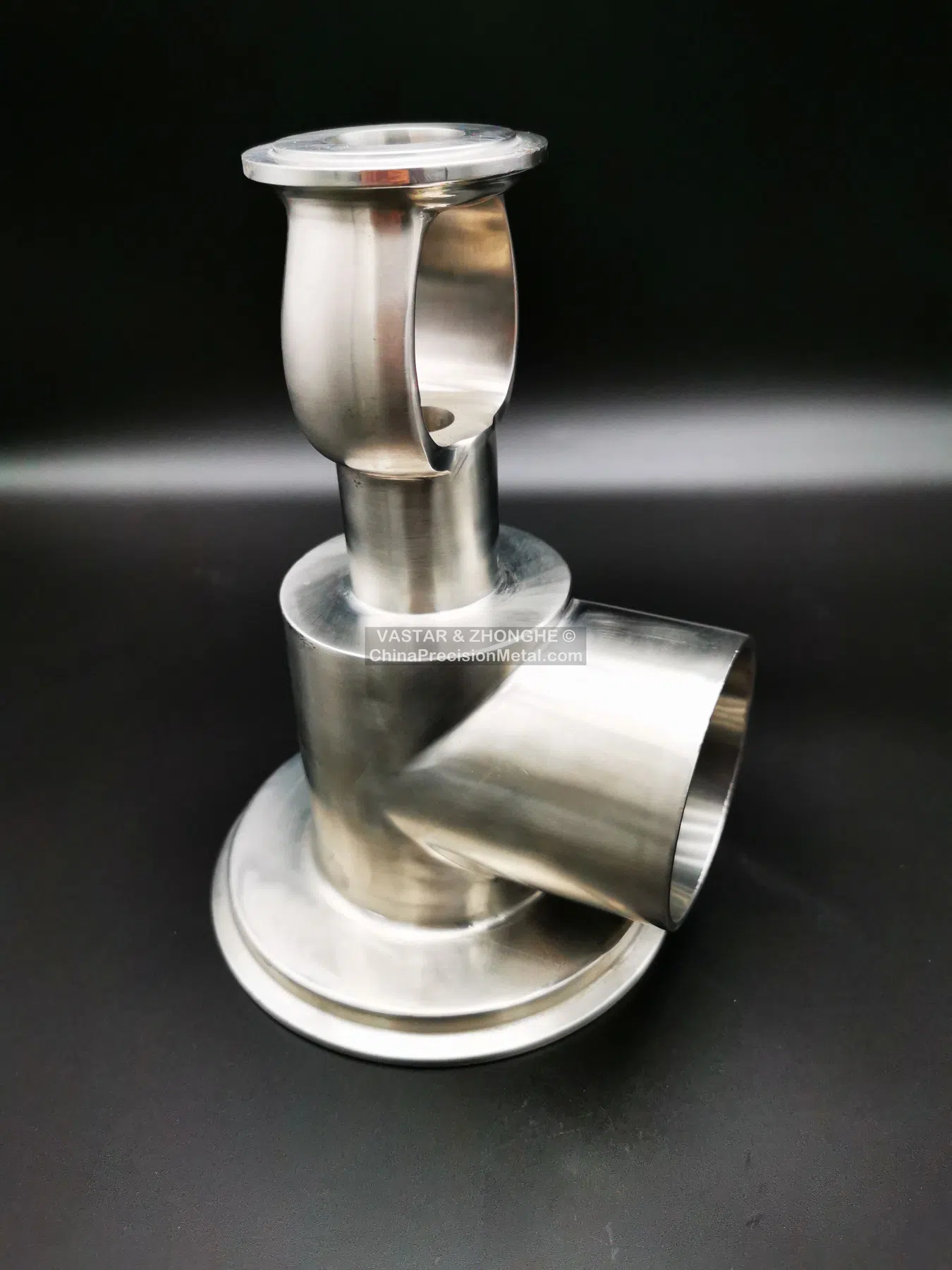
Component challenge
Sanitary and hygienic flow components are judged by more than external appearance. Product-contact geometry, internal transitions, dead-leg risk, surface roughness and cleaning compatibility all influence acceptance. A polished surface cannot compensate for an unsuitable radius, inaccessible pocket or poorly planned machining transition.
Investment casting can integrate branches, bosses and contoured flow paths. Machining then establishes clamp, seal, bore or assembly interfaces, while polishing removes the surface profile needed to reach the specified finish.
Process planning priorities
- Keep product-contact transitions smooth and accessible to finishing.
- Separate dimensional stock from the material allowance needed for polishing.
- Avoid parting, gate and blend locations in difficult hygienic zones.
- Define the finish by measurable roughness and direction, not by words such as “mirror” alone.
- Confirm whether passivation or electropolishing follows mechanical polishing.
Finishing and verification
A controlled abrasive sequence is used to remove casting texture and machining marks progressively. Internal and external surfaces may require different tooling and acceptance criteria. Roughness measurement should be taken at agreed locations with the specified cutoff and instrument settings.
After finishing, the component may require cleaning, passivation, electropolishing or dedicated packaging. Dimensional checks must account for material removed during polishing, especially at sealing edges and thin sections.
Useful RFQ information
State the product-contact surfaces, required Ra value, polishing direction, sanitary standard, passivation or electropolishing requirement, cleaning and packaging expectations, material grade and annual quantity.