
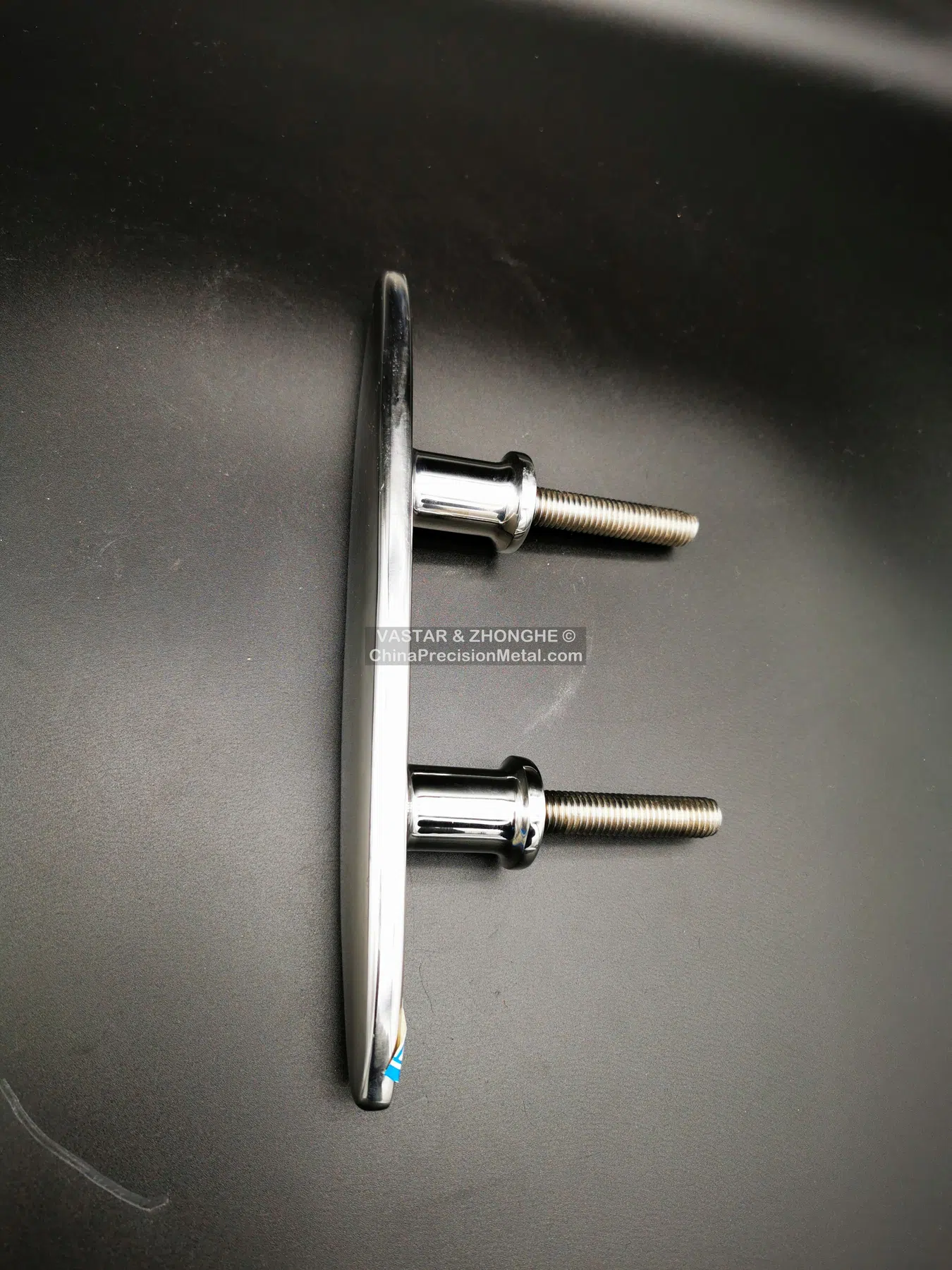
Component challenge
Marine cleats, fittings, hinges and deck hardware often combine sculpted external form with threaded holes, pins, mounting faces or bearing features. Investment casting can create the shape economically, while machining establishes assembly accuracy and polishing provides the final appearance and cleanability.
The finish is highly visible, which makes process consistency important. Casting texture, gate removal, blending, machining transitions and handling marks can all remain visible after polishing unless the sequence is defined from the beginning.
Process planning priorities
- Select a corrosion-resistant grade appropriate to the environment and specification.
- Place gates and parting features where blending is accessible.
- Leave controlled stock on mounting and mating surfaces.
- Define which surfaces are cosmetic, functional or intentionally left as-cast.
- Establish an approved finish sample and viewing conditions when appearance is critical.
Machining, polishing and verification
Machined threads, mounting faces and pin bores should be completed in an order that avoids damaging polished surfaces. Mechanical polishing proceeds through controlled abrasive stages, with local blending around cast details and machining transitions. Passivation may follow to restore a clean stainless surface.
Acceptance can include dimensional checks, thread gauges, roughness measurement, visual comparison to a master sample and corrosion testing when specified. Packaging must prevent contact marks during shipment.
Useful RFQ information
Send the material grade, exposure environment, load or assembly requirements, cosmetic zones, target finish or Ra, passivation requirement, salt-spray requirement, packaging expectation and annual quantity.