
Executive summary for industrial buyers
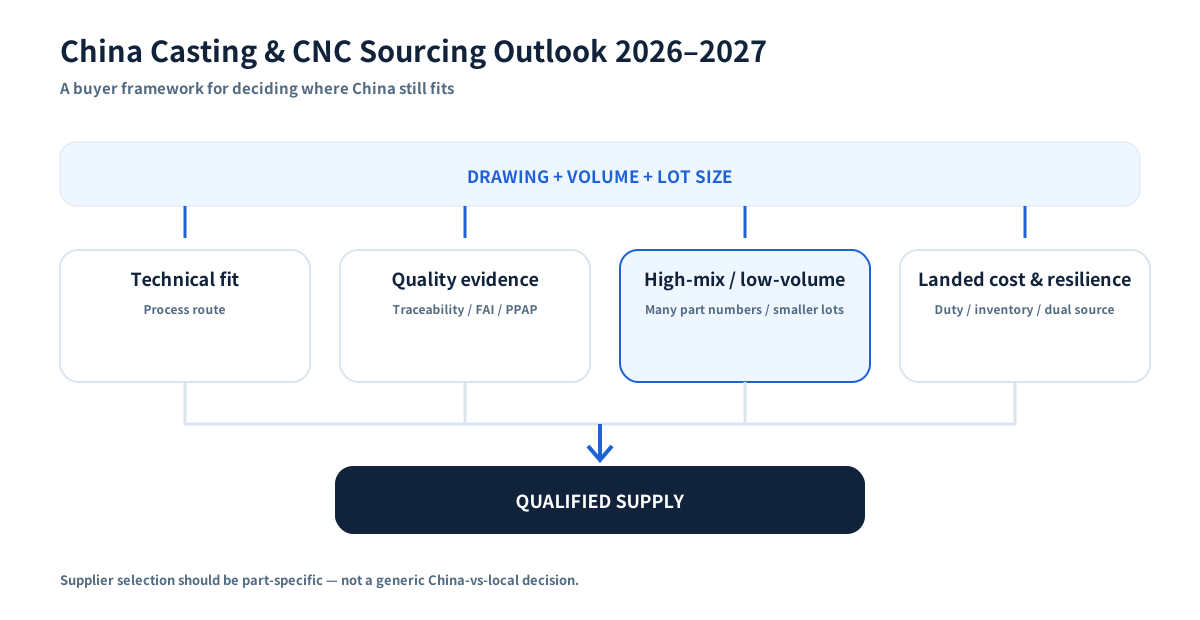
China remains a very large manufacturing and export base, but the sourcing environment in 2026 is more complex than the old model of selecting a supplier on piece price alone. Tariffs, trade-policy uncertainty, regional diversification, quality expectations and faster product cycles are pushing buyers toward a more deliberate question:
Which supplier and supply architecture gives the lowest risk-adjusted total cost for this specific component family?
For investment castings and CNC-machined industrial parts, the strongest China fit is often found where a buyer needs some combination of complex geometry, stainless or alloy materials, multiple secondary processes, many part numbers, flexible lot sizes, inspection evidence and repeat supply.
What the 2026 data says about China's manufacturing base
The WTO's March 2026 Global Trade Outlook reported that China's merchandise exports grew 5.5% in value in 2025 to about US$3.77 trillion, while export volume grew 9.2%. The same WTO analysis shows a major geographic shift: exports to the United States fell, while exports to the EU, ASEAN, India, Africa and South America increased.
China's National Bureau of Statistics reported that manufactured goods accounted for 95.8% of exports in 2025, with machinery and transport equipment at 51.8%. In the second quarter of 2026, capacity utilization in general-purpose machinery was 80.1%. July 2026 industrial data showed year-on-year value-added growth of 7.3% for metal products, 9.5% for general-purpose machinery and 12.6% for special-purpose machinery.
The picture is not uniformly strong: China's July manufacturing PMI was 49.2, below the 50 expansion threshold. For buyers, that combination suggests a large and capable industrial base operating in a more competitive and uneven market—not a simple story of either boom or decline.
China sourcing is being reconfigured, not simply abandoned
The 2026 sourcing trend is diversification. The US-China Business Council's 2026 member survey found 59% of respondents were reviewing their China supply chains, while describing the changes as incremental and industry-dependent rather than a uniform exit. A 2026 Allianz Trade global survey similarly found de-risking actions such as sourcing from new suppliers and market diversification had become common.
For an industrial procurement team, the practical implication is that China-or-not-China is the wrong level of analysis. The better question is how a China supplier fits into a dual-source, regional-stock, China+1 or category-specific strategy.
2026 signals and what they mean for 2027 buyers
| 2026 signal | 2027 sourcing implication |
|---|---|
| China remains a major machinery and manufactured-goods exporter | Deep process ecosystems and sub-tier availability remain a real advantage for complex industrial parts |
| Trade flows are becoming more regional and politically sensitive | Landed cost should include duty exposure, Incoterms, logistics and alternate-source options |
| Buyers are diversifying suppliers | Qualification evidence, continuity plans and the ability to work as one source in a multi-source strategy become more important |
| Product cycles are shortening | Prototype-to-production continuity and engineering-change responsiveness matter more |
| Quality systems are more visible to customers | Drawing control, material traceability, FAI/PPAP/Cpk where required, NDT and inspection records should be scoped before award |
| Many OEMs carry more variants and service parts | High-mix, low-volume capability can be more valuable than maximum line speed |
| Inventory remains expensive but stockouts are worse | Economic production lots can be separated from customer release quantities through stocking and scheduled releases |
Where China can still be a strong fit
Complex cast-to-machine components
China's value is strongest when the supply chain does more than pour a casting. A supplier that can coordinate investment casting + CNC machining + finishing + inspection + testing may remove handoffs, reduce duplicated logistics and make one party responsible for the finished drawing.
Typical examples include valve bodies, pump housings, impellers, flow components, sanitary hardware, pressure-boundary parts and industrial machinery components.
Stainless, duplex and alloy parts with multiple secondary operations
When a part needs casting, heat treatment, machining, polishing/passivation, NDT and dimensional inspection, the cost of managing sub-tier suppliers can become as important as the raw process cost.
High-mix, low-volume industrial programs
This is a distinct supplier model. High-mix, low-volume (HMLV) work means many part numbers, relatively small production lots, controlled revisions and frequent changeovers. It is common in industrial equipment, pumps and valves, replacement parts, custom machinery and developing product families.
China Precision Metal's manufacturing model is intentionally suited to this type of work. We do not publish a universal minimum order quantity because the economic lot depends on tooling, alloy, part weight, setup and inspection scope. The goal is to find a practical batch size for each part number, then use repeat scheduling or stocking when the customer's consumption quantity is smaller than the most efficient production lot.
Programs that benefit from one engineering conversation
A casting foundry, machine shop, polishing supplier and test lab can each produce a technically acceptable operation while the final part still fails. Integrated responsibility is valuable when datum strategy, machining stock, pressure integrity and surface requirements interact.
When another sourcing route may be better
China is not automatically the correct answer.
A local or alternate source may be better when:
- the quantity is extremely low and tooling cannot be justified;
- the part can be machined quickly from standard local stock;
- emergency lead time matters more than unit cost;
- the product is subject to localization, defense, export-control or mandated-origin rules;
- design changes are occurring so frequently that production tooling would become obsolete;
- the cost or risk of international logistics overwhelms the manufacturing saving;
- the buyer cannot resource supplier qualification, incoming control or change management.
Good sourcing decisions include a reason not to source a part from China when the economics or risk do not support it.
High-mix, low-volume deserves its own qualification questions
A factory optimized for one high-volume automotive part is not automatically good at 80 industrial part numbers released in small lots. Buyers evaluating HMLV suppliers should ask:
- How are drawing revisions and active part numbers controlled?
- How are tools, fixtures, gauges and programs identified and stored?
- How are small lots scheduled without mixing heats or revisions?
- What is the changeover and first-piece approval process?
- Can casting, machining and finishing records be linked to the same lot?
- How are dormant service parts restarted after a long gap?
- Can economic production lots be decoupled from customer release quantities through stocking?
- How are quality records retained when many part numbers are active simultaneously?
These questions often reveal more than a headline machine count.
A 2027 buyer checklist for Chinese casting and machining suppliers
Commercial fit
- Ask for the finished-part quotation, not only the raw casting price.
- Separate tooling, sample, production, inspection and logistics costs.
- State annual demand and expected release / lot size.
- Compare total landed cost under the actual Incoterm.
Engineering fit
- Send controlled 2D and 3D data together.
- Define material standard, heat treatment and repair restrictions.
- Mark critical datums, seal faces, pressure boundaries and surface requirements.
- Allow the supplier to challenge the starting process if casting, forging or billet machining would be better.
Quality fit
- Match the control plan to component risk.
- Define FAI, PPAP, Cpk or capability-study requirements where they are actually needed.
- Specify NDT method and acceptance standard rather than simply writing "NDT required."
- Confirm material and lot traceability before first production.
Supply-chain fit
- Understand which processes are in-house and which are sub-tier.
- Ask how backup capacity and tooling recovery are handled.
- Decide whether the part belongs in a single-source, dual-source or regional-source strategy.
- For repeat programs, evaluate safety stock and scheduled releases instead of forcing every production batch to match weekly consumption.
Do not confuse lowest piece price with lowest total cost
A cheaper casting can become expensive after extra machining, sorting, rework, air freight or line disruption. A more expensive billet part may be correct for a prototype because it avoids tooling. A larger production lot may reduce manufacturing cost but create excess inventory unless releases are decoupled from production.
The relevant equation is closer to:
finished component + quality risk + tooling + inventory + logistics + engineering change + supplier-management effort
than to raw piece price alone.
Outlook for 2027
Our expectation is that industrial sourcing from China will become more selective rather than simply smaller. Buyers will continue to diversify critical supply chains, but China's depth in machinery, metalworking, tooling and industrial sub-tiers will keep it relevant where process integration and manufacturing economics are strong.
The suppliers most likely to remain useful to Western and global OEMs will be those that can show:
- technical fit rather than generic capability claims;
- reliable documentation and traceability;
- flexibility across many part numbers and smaller lots;
- transparent sub-tier and quality-control arrangements;
- responsiveness to engineering change;
- options for stocking, scheduled releases and regional risk reduction;
- credible communication when a requested process is not the best one.
RFQ takeaway
A useful China sourcing comparison starts with the finished drawing, annual demand, expected lot size, material, inspection scope and delivery model. For high-mix industrial programs, include the number of active part numbers and revision frequency as well. Those inputs are more useful than asking a supplier for a generic MOQ or a single benchmark piece price.